November SPECIAL OFFER! Sign-up to our newsletter to receive the latest offers and news.
Coffee Table With Storage: Practical Solid Wood Designs for Living Rooms
Your remote is under a magazine, the coasters have disappeared, and there is nowhere to put your cup. A coffee table with storage keeps these everyday items close without filling the tabletop. Solid wood designs combine a durable surface with shelves, drawers or cupboards; choose around what you need to hide or reach, then check the height, footprint and opening clearance against your sofa.
We recommend judging storage by how easily you can use it, rather than by capacity alone. A modest shelf earns its place when a larger drawer cannot open comfortably.
Key Takeaways
Choose drawers for small clutter and cupboards for bulkier items.
Open shelves give quick access, but leave contents visible.
Measure internal storage, not just the table’s outside dimensions.
Allow space for openings as well as everyday movement.
Confirm solid hardwood construction; an oak finish proves nothing.
Shelves, drawers or cupboards?
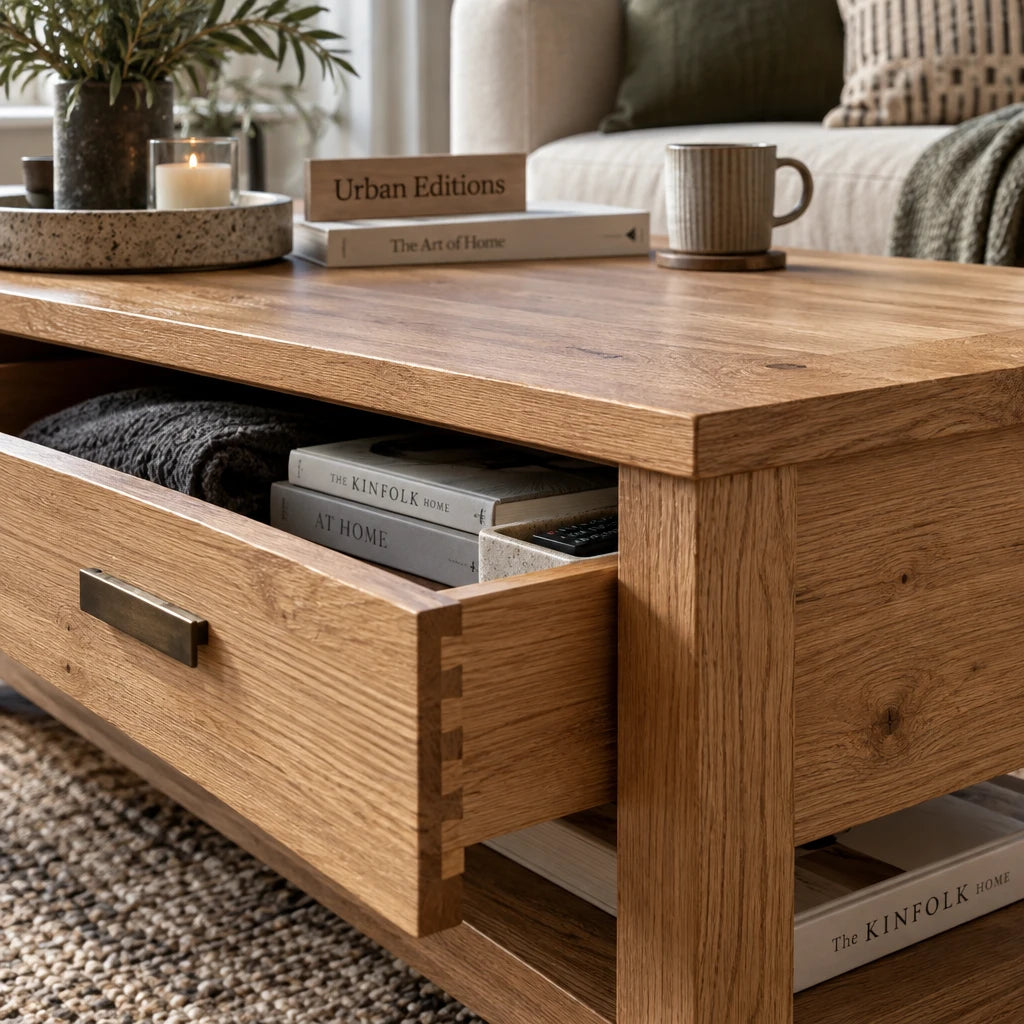
Drawers are the strongest starting point for everyday clutter, while shelves suit frequently used books and cupboards conceal larger objects. A combination works well when you want quick access to some items and a clear view elsewhere.
Start with the things that currently collect beside your sofa. Their size and frequency of use matter more than the number of compartments.
Storage design
Best suited to
Access needed
Main limitation
Open shelf
Books, magazines and a small basket
Clear space at the shelf opening
Contents remain visible
Drawers
Remotes, coasters, chargers and small accessories
Space for the drawer’s full extension
Drawer sides and runners reduce usable room
Cupboard
Games, larger accessories and folded textiles
Space for the door’s swing
Items at the back take longer to reach
Lift-top compartment
Larger items used less frequently
Clear lifting path above and beside the table
Access involves moving the tabletop
Open shelves
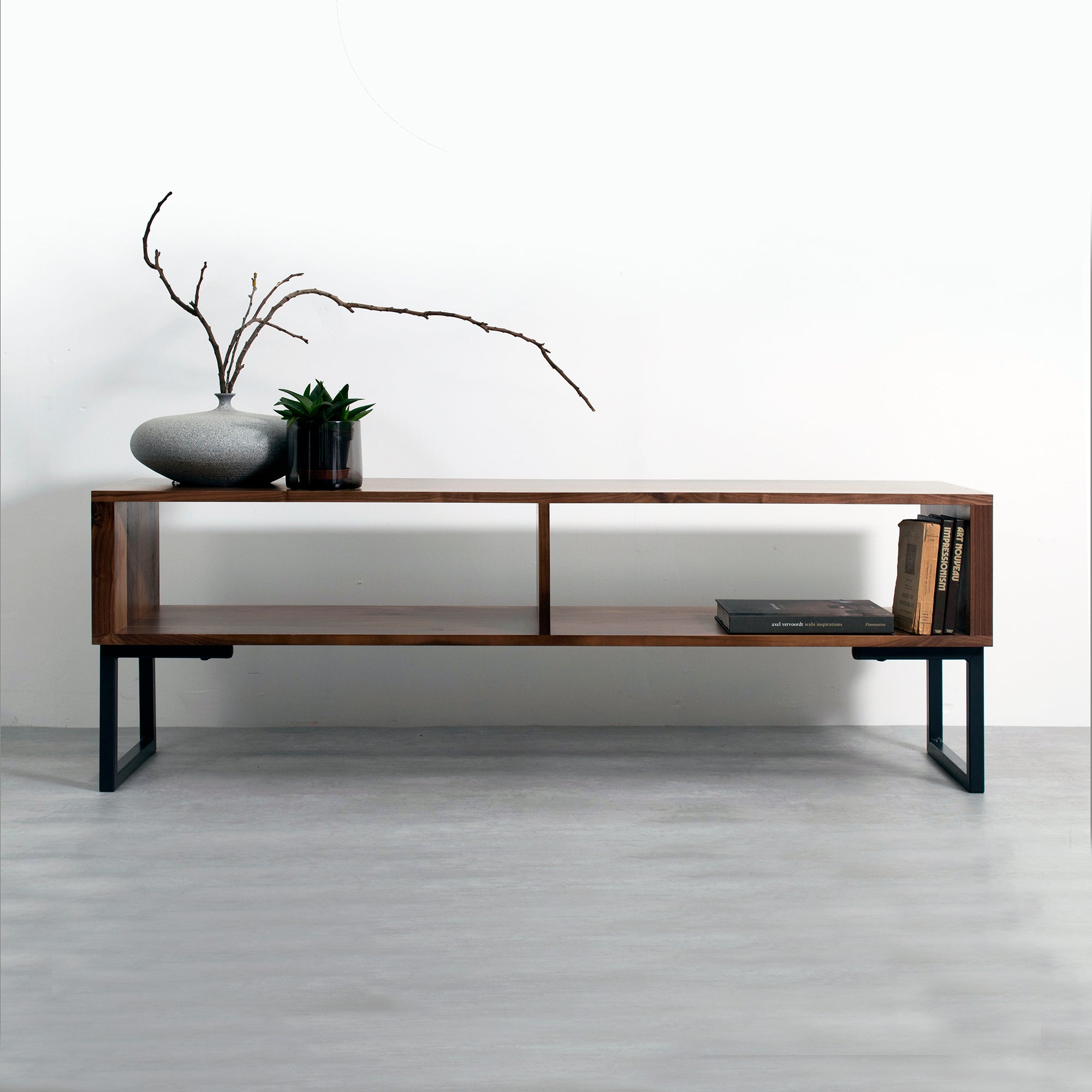
An open-shelf coffee table gives you direct access without moving a door or drawer. It works particularly well where seating sits close to the table, provided you can reach the opening from your usual position.
Keep the contents deliberate: a short stack of books and one basket look calmer than loose cables and paperwork. Open storage does not conceal clutter. A basket adds concealment, but its height and handles need to fit beneath the tabletop.
Drawers and cupboards
Drawers bring smaller objects towards you, making them easier to find than items pushed behind a cupboard door. For remotes and coasters, shallow storage is usually more useful than a deep compartment where things become buried.
Cupboards suit objects that need height, such as a stack of board games. Check whether a central divider, hinge or fixed shelf restricts the opening. A wide cupboard front does not necessarily mean you can slide one wide object inside.
A mixed design avoids forcing every item into the same arrangement. Use a drawer for loose accessories and an open shelf for the book you are reading. Choose cupboard storage instead when the objects you want to hide are bulky rather than numerous.
Size it to your sofa
A coffee table should sit roughly level with your sofa cushions or slightly below them. For length, about two-thirds of the sofa’s width is a useful starting point, but the available walking space decides the final size.
Height and reach
Many coffee tables are around 40–45 cm high. Measure your own sofa rather than buying to that range automatically: a low, deep sofa needs a different relationship from upright seating with higher cushions.
Aim for a tabletop around 2.5–5 cm below the seat cushion as a practical guide. If your cushion sits 45 cm above the floor, a table around 40–42.5 cm high gives you that relationship. Test the height with a box before ordering, especially if reaching down is uncomfortable.
For a sofa 210 cm wide, the two-thirds guide gives a table length of about 140 cm. Treat that as a proportion check, not a target to squeeze into the room. A shorter table is the better choice when the larger one blocks your route.
Small-room shapes
Round and oval tables ease movement where people pass close to the corners. A round table around 80–90 cm across often works in compact seating arrangements, although its widest point still needs the same clearance as any other shape.
An oval table suits a longer sofa when you want useful surface length without projecting corners. A narrow rectangle is often more space-efficient in a long, slim room. Choose the shape that follows your route through the furniture, rather than assuming round always means smaller.
Walking clearance
Leave at least about 40 cm between the sofa and table as a starting point. That gives you room to move your legs and reach the surface. Where the gap is a main route through the room, aim for roughly 75–90 cm instead.
Draw the full arrangement on paper. For example, 180 cm between the sofa front and TV unit allows a 60 cm-deep table, a 40 cm sofa gap and an 80 cm passage beyond it. The result is workable circulation, before accounting for any drawer or door openings.
Measure usable storage
External dimensions tell you whether a table fits the room. Internal dimensions tell you whether your belongings fit the table. Check both before comparing designs, particularly when thick timber, drawer runners or dividers take up part of the space.
Inside dimensions
Measure the largest item you intend to store, including covers, handles and any protective case. An A4 sheet measures 21 × 29.7 cm, but a folder holding it is larger. A compartment that fits loose paper may not accept the folder you actually use.
Check width, depth and height separately. As an illustration, a compartment measuring 50 cm wide, 35 cm deep and 12 cm high will not take a 14 cm-high games box, despite having ample width.
For drawers, ask for the usable measurement inside the drawer box, not the width of the front. Also establish how far it extends. A drawer that opens only partway can make its rear section awkward to reach beneath a low tabletop.
Opening space
Mark the proposed table on the floor with masking tape, then add its moving parts. This simple check is more revealing than looking at the footprint alone.
Measure the sofa height and mark the table’s closed footprint.
Mark the full drawer extension or cupboard door swing.
Sit down and test where your knees and feet naturally rest.
Stand beside the marked opening and allow room to use it.
Walk your usual route past the table towards the door.
For example, a drawer extending 30 cm into a 40 cm sofa gap leaves only 10 cm between its front and the sofa. It may open, but using it comfortably from that side is another matter.
For a hinged cupboard, use the door width to sketch its approximate swing, then account for the actual hinge arrangement. A 35 cm-wide door needs roughly that much depth at a right angle. Choose the access side deliberately; opening towards a clear end of the sofa can work better than opening towards the seat.
Solid wood or veneer?
Solid hardwood has wood throughout the thickness of the component. Veneer is a thin layer of real wood bonded to another material, often plywood or MDF. Both can look attractive, but they behave differently when damaged or refinished.
A wood species describes the timber; it does not, by itself, describe how the whole piece is constructed.
Read the description
An oak finish describes appearance, not solid oak construction. Even a table described simply as oak may combine solid parts with veneered panels. Look for clear material details for the top, legs, frame, storage panels and drawer components.
Veneer is not automatically a poor material. A well-made veneered panel provides a real wood surface and can remain flatter across broad areas. Its limitation is the thin surface layer, which leaves less room for sanding than solid wood.
Photographs offer clues, but not proof. End grain at the end of a board supports a solid wood description; an applied edge or a wrapped veneer can imitate it. Ask for a component-by-component description when the wording is unclear.
Look beyond thickness
For long-term ownership, we favour clearly specified solid hardwood where you want the option of future surface restoration. That does not make the finish immune to rings, scratches or dents. Use coasters and wipe up spills promptly.
The main objection is understandable: solid hardwood often costs more than veneered construction. Choose it for the material and the potential to renew a suitable surface, rather than expecting freedom from wear.
Solid wood also expands and contracts as indoor moisture levels change. Good construction allows that movement through suitable joints and fixings. A thick top alone tells you little about this detail, or about how smoothly its drawers operate.
Before choosing, examine how the storage works as well as how the surface looks. Drawer alignment, a stable base and sensible access will affect everyday use more directly than an extra few millimetres of timber.
When does a lift top earn its place?
A lift-top coffee table is worth choosing when you regularly need the surface closer to your seated position. It is less useful when your priority is simply reaching a remote, because opening the storage moves a much larger part of the table.
The best mechanism is the one that suits the job…
Raised use
Some lift tops rise vertically; others rise and move towards the sofa. The second arrangement brings a laptop or plate closer, but it also changes the space occupied by the table.
Measure the raised position as carefully as the closed one. For example, if a top moves 25 cm towards a sofa across a 40 cm gap, only 15 cm remains horizontally between its leading edge and the sofa front. Check the raised height too, so the top clears your knees and reaches a useful working level.
A raised surface does not turn a soft, low sofa into a desk chair. Choose this feature for occasional tasks rather than treating it as a substitute for a properly arranged desk.
Access and mechanisms
Check whether you need to clear the tabletop before opening it. A design that requires moving your cup, books and tray every time you fetch a charger creates more work than a drawer.
The mechanism also occupies some of the space beneath the top. Look at the actual clear storage area and the stated load limits for both the raised surface and the compartment.
Choose independent drawers or shelves when frequent access matters most. Choose a lift top when you will use the raised surface often enough to justify its moving parts and opening routine.
Hardwood and restrained styling
Oak, walnut, ash and iroko each give a storage coffee table a different presence. Choose the timber alongside the table’s proportions and storage layout: a pale finish cannot make an oversized cupboard base feel small.
Four hardwood choices
Oak has a pronounced grain and suits both clean-lined and more textured interiors. It is a useful choice when you want the wood to remain a visible feature without making the table especially dark.
Walnut usually brings deeper brown tones and varied grain. It works well with slim proportions and warm upholstery, although a broad, enclosed walnut base will have more visual weight than an open-legged design.
Ash is generally pale, with a clear, often lively grain. It suits rooms where you want a lighter-looking centrepiece, particularly alongside white walls or fabrics in muted colours.
Iroko commonly has golden to medium-brown tones and darkens with exposure. Judge it as a timber with changing character rather than expecting its colour to remain exactly as it appeared when new.
Minimalist or mid-century?
For a minimalist room, favour uninterrupted fronts, simple handles and a limited number of visible compartments. Concealed storage supports that calm appearance, but allow enough practical access to avoid sacrificing function for a clean outline.
Mid-century modern styling often uses raised legs, tapered profiles and warm timber. Those details let you see more floor beneath the table. Check that the legs leave useful shelf access rather than narrowing the opening at each end.
Keep the top restrained: one tray for small items and space for drinks is enough. You do not need to fill every shelf, either. Leaving part of a lower shelf empty makes the table easier to use and reduces visual clutter.
Samples and customisation
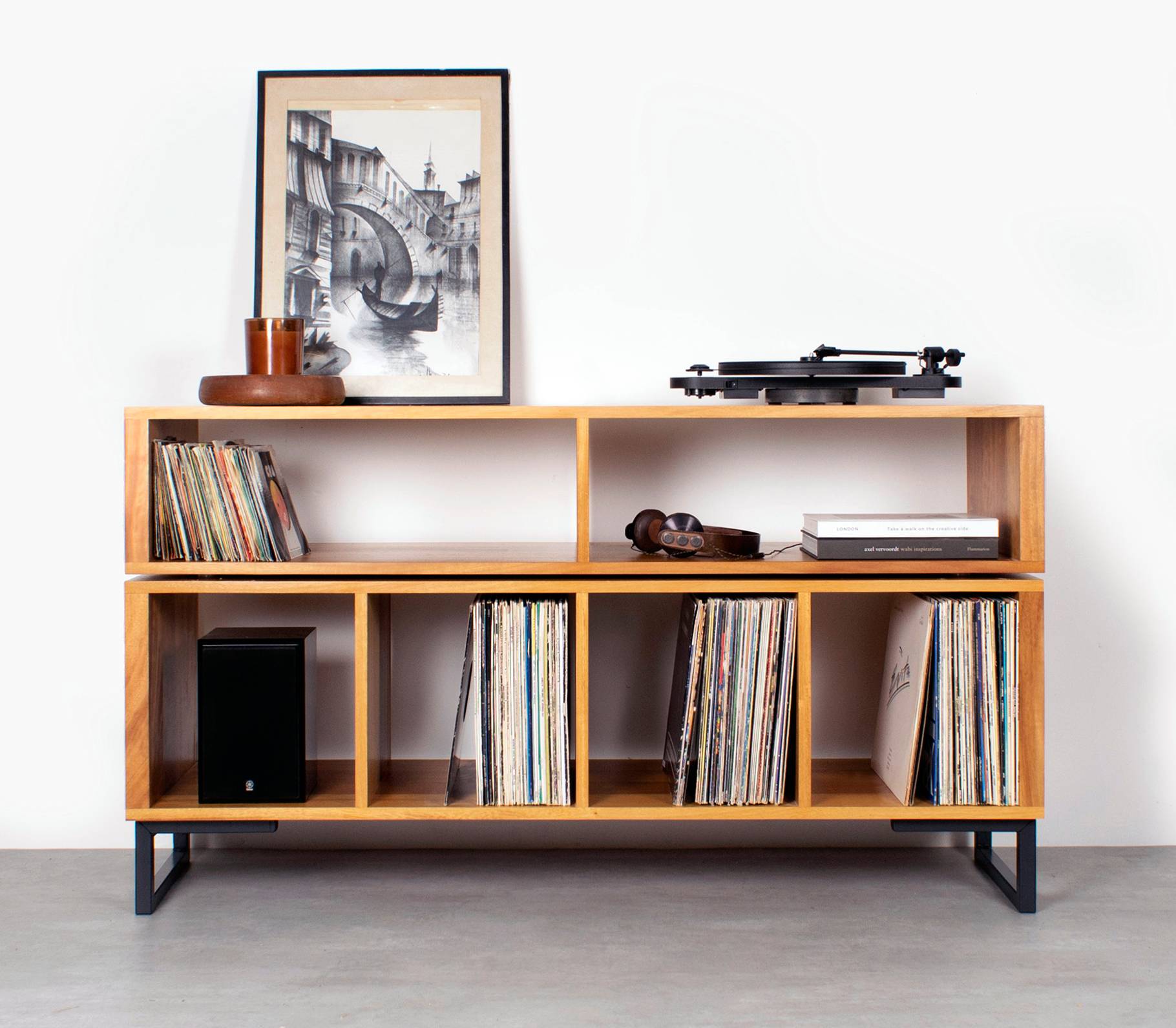
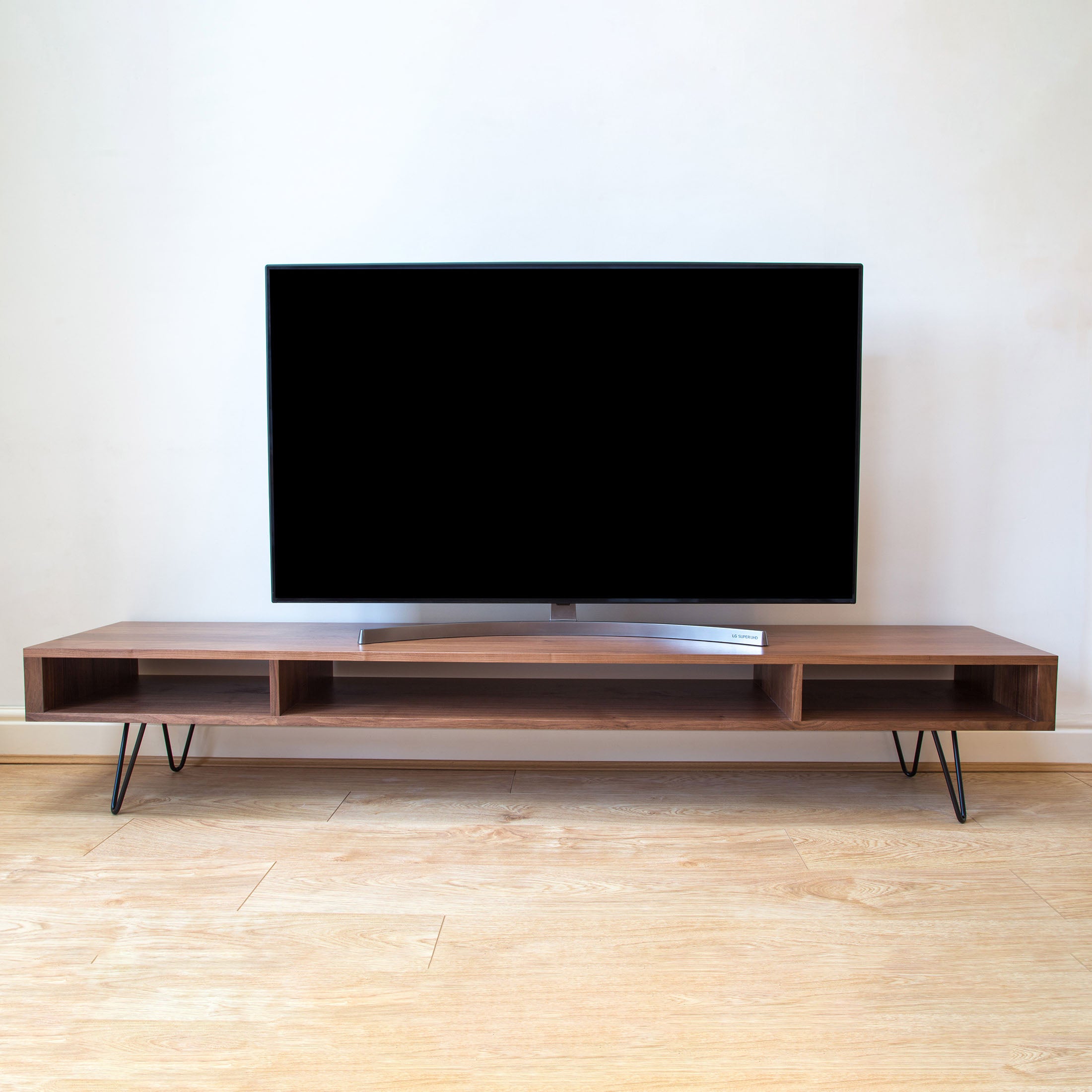
Compare wood samples beside your sofa, flooring and TV stand in daylight and under your evening lighting. You are choosing how the materials sit together, not trying to make every grain pattern identical.
Custom dimensions are most valuable when they solve a measured problem, such as reducing depth to preserve a walkway. Be precise about whether you need a smaller footprint, a different height or more usable internal space.
You can browse our coffee tables at Urban Editions, select hardwood options and order samples to compare at home. Our designs are made to order in a family-run UK joinery, with customisation available. Start with your required dimensions and storage arrangement, then choose the wood that suits the room.
Conclusion
Put masking tape on the floor before you choose the timber. Mark the table, its openings and the route you use most often. If a drawer cannot open comfortably, choose access from another side or use an open shelf. Once that layout works, compare internal measurements against the belongings you want to store. You will have a clear specification for choosing a table, rather than a photograph to fit your room around.
Frequently Asked Questions
Which storage design is best for everyday clutter?
Drawers work best for small everyday clutter such as remotes, coasters and charging cables. Choose a cupboard for bulkier objects, or combine a drawer with an open shelf when you also want books within easy reach.
What shape coffee table works best in a small living room?
Round or oval tables usually make tight corners easier to pass, while a narrow rectangle can fit a slim room better. Mark the widest part of each shape on the floor and compare the walking space left around it.
Can a solid wood coffee table be refinished?
Many solid wood surfaces can be refinished, depending on their existing finish, construction and condition. Follow the care guidance for the particular table; some finishes accept local treatment, while others need a larger area refinished to achieve an even appearance.
Should a coffee table match the TV stand?
No, your coffee table does not need to match the TV stand exactly. Connect them through a shared warm or cool wood tone, similar leg shapes or a consistent level of detail, rather than trying to reproduce the same colour and grain.