November SPECIAL OFFER! Sign-up to our newsletter to receive the latest offers and news.
Mid-Century Vinyl Storage: Choosing a Record Cabinet on Hairpin Legs
100 records pressed at 180 g weigh 18 kg before you add their sleeves. Choose mid-century vinyl storage on hairpin legs by checking usable internal dimensions, upright record support and the whole-cabinet load rating before its appearance. Slim legs alone do not establish strength.
Allow space for sleeved LPs and collection growth, then choose a leg height that suits browsing and turntable use. We recommend working from the records outwards: establish what your collection needs, then choose the proportions and hardwood that fit your room. The right cabinet should make your records easier to use, rather than simply give them somewhere to sit.
Key Takeaways
Calculate capacity from clear internal width, not outside dimensions.
Allow approximately 33 cm internal height and depth for sleeved LPs.
Measure thicker sleeves and box sets separately.
Check cabinet and shelf ratings, not individual leg claims.
Choose leg height alongside cabinet and turntable height.
Leave usable space for your next records.
How much space do your records need?
Allow approximately 3 mm of shelf width per sleeved record as a starting point, then measure a representative section of your collection. This allowance gives ordinary LPs some browsing room, but gatefold sleeves, double albums and box sets change the result.
Clear dimensions
For ordinary sleeved LPs, start with approximately 33 cm of clear internal height and depth. A 12-inch record measures about 30.5 cm across, but its cover and protective outer sleeve need more room.
Measure your largest sleeves before choosing the cabinet. Oversized packaging can exceed a standard compartment, while a tight opening makes records awkward to remove even when they technically fit.
Clear internal dimensions are the unobstructed spaces inside the cabinet. Side panels, dividers, doors and hinges all reduce what you can use. A cabinet sold as 80 cm wide does not provide 80 cm of record storage.
Usable record space is the clear space available after panels, dividers and fittings have been accounted for.
For a closed cabinet, measure depth to the inside of the closed door. An LP that projects slightly from an open shelf may be accessible; the same arrangement behind a door will prevent it closing.
Real capacity
At the 3 mm planning allowance, 150 sleeved records need about 45 cm of usable shelf width. If you want space for 225 records, allow about 67.5 cm, divided between suitable bays.
Treat these as planning figures rather than a guaranteed record count. Measure a mixed selection of 20 albums, including your thicker releases. If they occupy 8 cm, that part of your collection averages 4 mm per album, so 150 similar albums need about 60 cm.
Count box sets by their measured width rather than treating each box as one ordinary LP. A 5 cm box uses the same shelf width as roughly 16 records at the 3 mm allowance.
Growing room
For an actively growing collection, we recommend planning for 50% more records than you own now. That gives a useful starting point without assuming every collector buys at the same rate.
Use your buying habits to refine it. If you own 120 records and add two each month, you will have 168 after two years. Space for 180 gives you 12 additional places beyond that forecast.
Leave enough movement to separate sleeves with your fingers. A cabinet filled tightly from end to end has reached its practical capacity before every last millimetre disappears.
Strength comes from the whole cabinet
Hairpin legs can support a full record collection when the legs, fixings and cabinet are designed together for that load. Their slender appearance is not the problem. The mistake is treating a strong metal leg as proof that every other part is equally strong.
Load ratings
Look for a whole-cabinet load rating, alongside any separate limits for the shelves and top. A total rating does not automatically mean the full load can sit on one shelf or at one end.
Do not multiply a quoted per-leg rating by four and treat the result as the cabinet’s safe capacity. The cabinet base, joints, mounting plates and screws all sit between your records and the floor.
Estimate your collection’s weight using a representative batch, including sleeves. For example, if ten albums weigh 2.8 kg, 150 similar albums weigh about 42 kg. Add an 8 kg turntable and the stored load becomes 50 kg, before other equipment or future records.
That example needs a cabinet rated above 50 kg for the intended load arrangement, with additional capacity for growth. Confirm once whether the quoted figure means supported contents or includes the furniture’s own weight, because manufacturers describe ratings differently.
Upright support
Store LPs upright, with enough support to stop a partly filled row leaning heavily. Dividers shorten the unsupported run and let you organise records without packing every compartment full.
A broad shelf also places greater demands on its construction. Solid hardwood alone does not establish a shelf’s capacity: thickness, unsupported span, joints and support positions matter too.
Check how the leg plates attach to the base. Screws need suitable timber to grip, and the plates should sit flat without loose fixings. If you are fitting legs yourself, follow the specified fixing method rather than choosing screws by appearance.
Finally, assess the assembled cabinet on your actual floor. A loose fixing and an uneven floor can both cause movement, but they need different remedies. Support partly filled record bays with a secure bookend or divider, rather than letting sleeves lean against the next compartment.
What changes with 10, 20 or 30 cm legs?
Choose hairpin leg height by adding it to the cabinet body height, then checking the resulting top against your listening position. Taller legs give more floor clearance and lift the records towards you, but they also raise any turntable placed above them.
The following comparison uses an illustrative 40 cm-high cabinet body, not the dimensions of a particular product.
Hairpin leg height
Overall cabinet height with a 40 cm body
Access and clearance implications
10 cm
50 cm
Low profile; less space beneath for cleaning
20 cm
60 cm
More floor clearance; less bending to reach records
30 cm
70 cm
Highest browsing position; raises the turntable top by 20 cm versus 10 cm legs
The difference between 10 and 30 cm legs is substantial in use. A low cabinet can suit browsing from a nearby chair, while a higher top reduces bending when you change records standing up.
Do not choose solely from the empty space beneath the cabinet. Leg plates, angled rods and the lowest part of the body can affect actual clearance. If a cleaning tool needs to pass underneath, measure its height and width against the clear route.
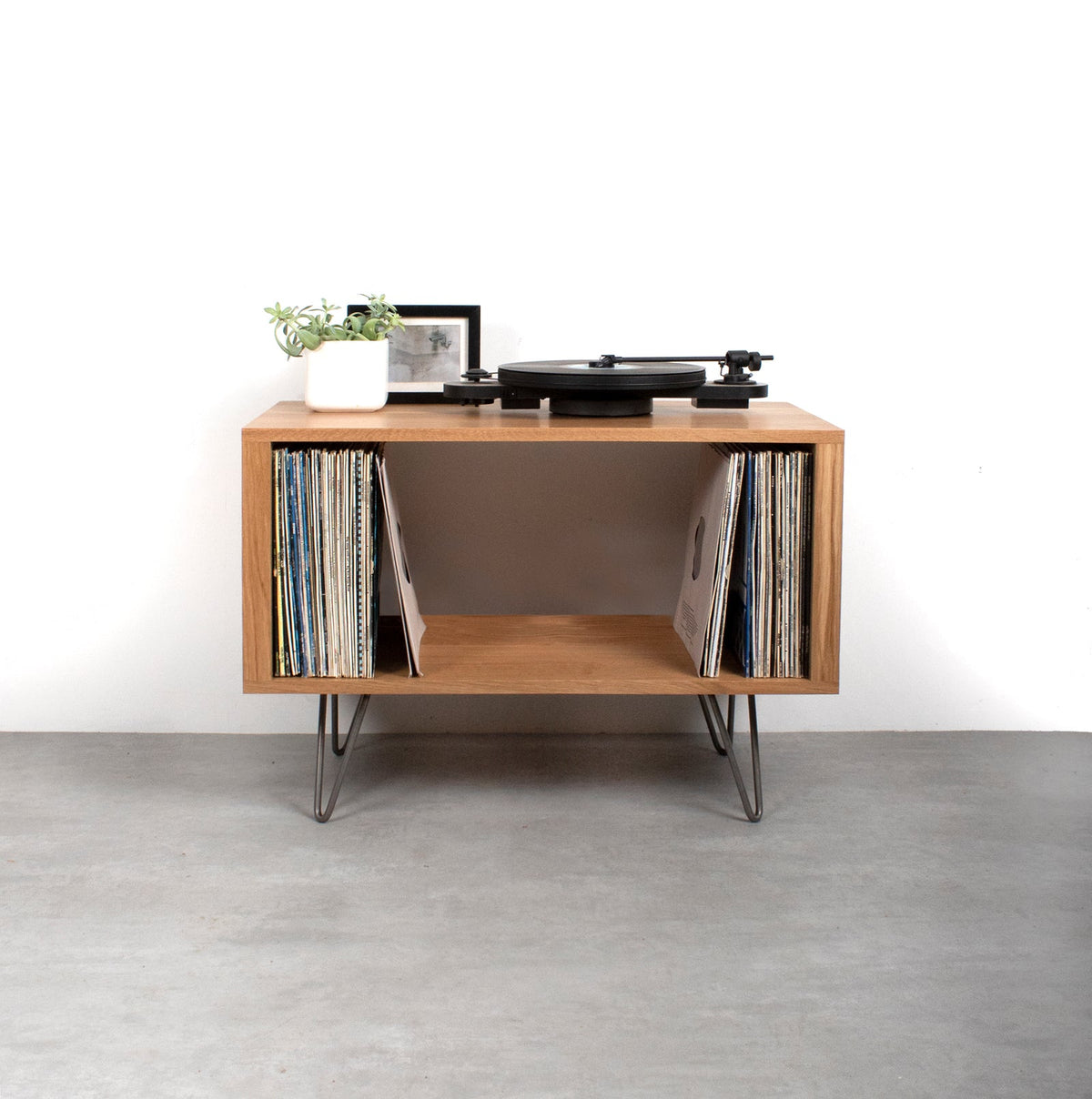
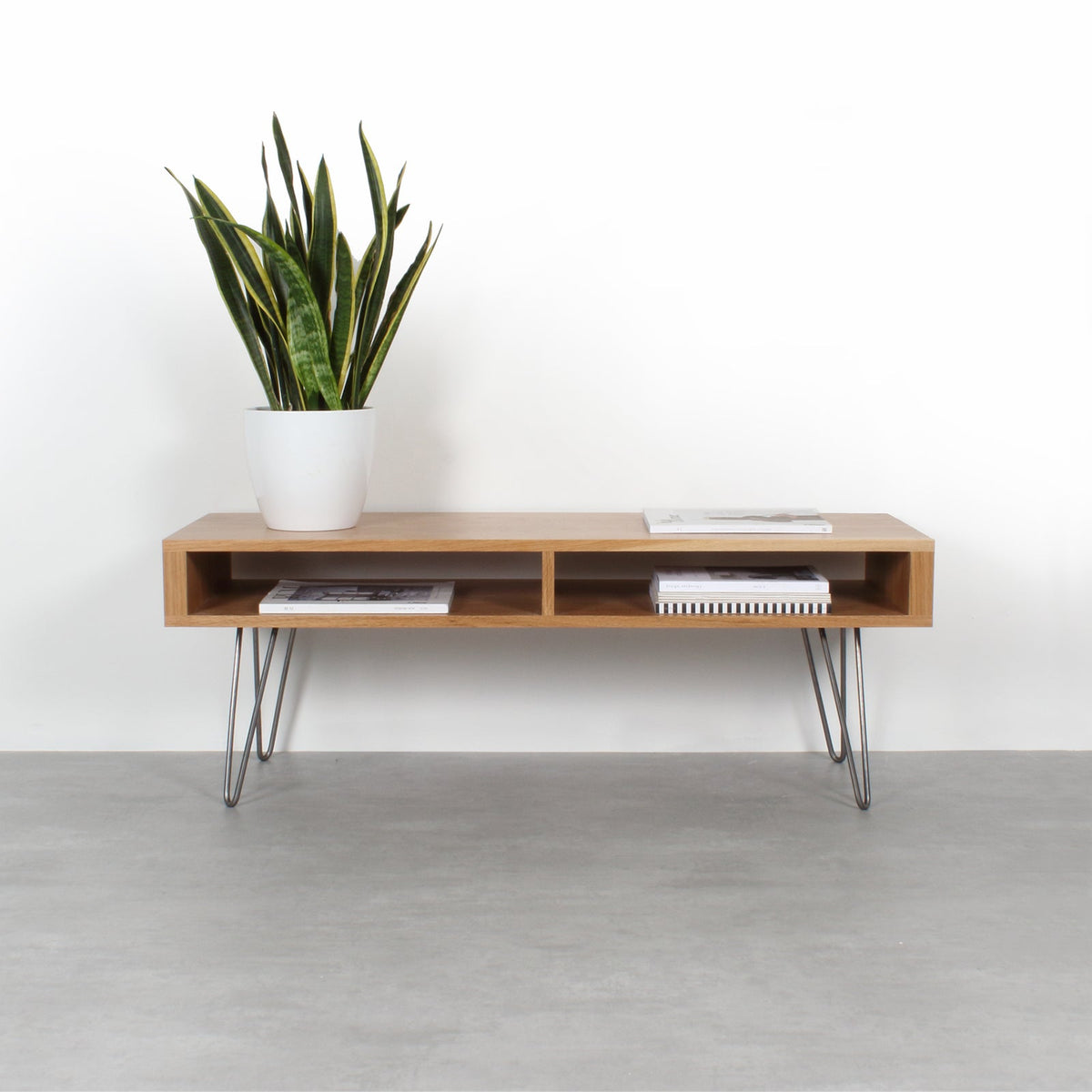
Our Stanton Vinyl Storage cabinet on Hairpin Legs pairs linear proportions with hairpin legs for an understated mid-century style. This solid wood design for a small vinyl collection comes in 60 cm and 80 cm widths, with 10 cm, 20 cm or 30 cm legs. Its hardwood options include European oak, iroko, ash and American black walnut.
Use those outside widths to judge the footprint in your room, not to calculate record capacity. When comparing vinyl cabinets and media units, match the usable bays to your collection first, then compare the overall height and proportions.
Mark the proposed top height on your wall with removable tape. Stand beside it and mime lifting a record onto the platter. It is a simple check, but more useful than judging height from a photograph.
Hardwood and mid-century proportions
A simple timber cabinet raised on slender metal legs gives you the familiar mid-century balance of a substantial body and an open base. Hairpin legs contribute to that appearance, but the cabinet’s width, height and grain are just as visible.
Choose the wood colour in your room’s light. Oak generally brings a warm, pronounced grain; ash often has a lighter appearance and strong grain lines. American black walnut offers deeper brown tones, while iroko commonly has golden to darker brown colouring.
A dark finish on ash changes its colour without removing the character of the grain. Look at the named finish as well as the timber species when comparing options.
There is a practical reason to keep the design simple. Open bays make spines easy to browse, while a long, uncluttered top leaves room to handle sleeves. Decorative details earn their space only when they do not obstruct access.
Solid wood varies naturally between boards, so expect differences in colour and grain rather than an exact repeat of a small sample. For daily use, follow the care instructions supplied for the finish; an oiled surface and a lacquered surface do not necessarily need the same treatment.
Avoid placing the cabinet where records receive direct sun or sit beside a radiator. That placement matters more to the collection than matching every timber tone elsewhere in the room.
Can the cabinet hold your turntable too?
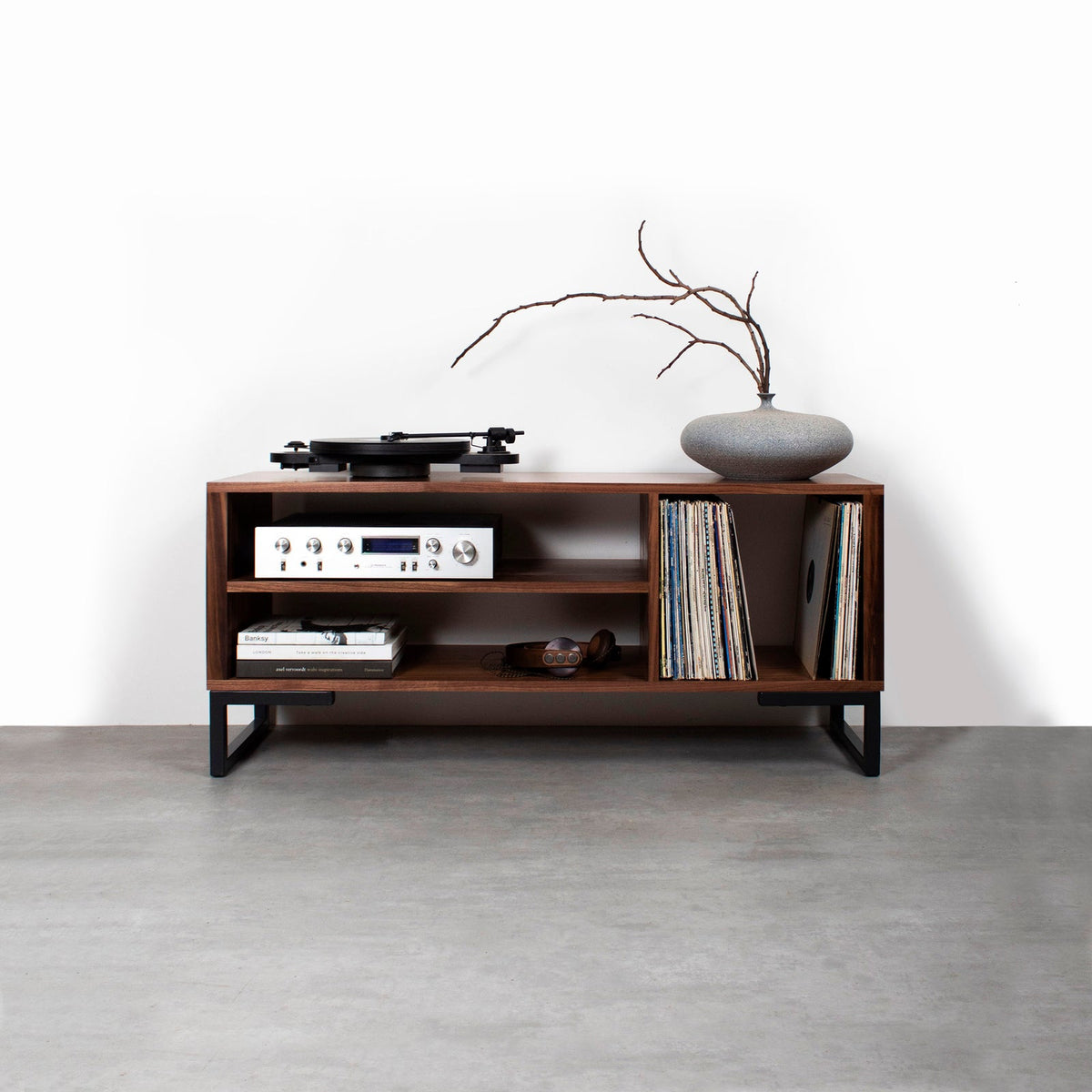
Yes, a vinyl storage cabinet can also hold a record player if its top is large enough, its load rating covers the equipment, and the assembled unit stays steady. Check the turntable with its lid open and cables connected, not just against its closed dimensions.
Footprint and cables
Measure the turntable’s width and depth, then identify where its feet sit. All feet need full support on the cabinet top; an overhanging body does not tell you whether the equipment is properly supported.
Suppose your turntable measures 43 cm wide and 36 cm deep, and its rear plugs need another 5 cm. You need at least 41 cm of usable depth before allowing any additional space required by that model.
That is a worked example, not a standard turntable size. Use your equipment’s actual measurements, including protruding sockets and any separate power supply.
Leave a place for the sleeve you are playing. A top that fits the turntable exactly can still be frustrating if every record change requires clearing another surface.
Lid clearance
A hinged dust cover needs space above and often behind the turntable as it opens. A shelf, sloping ceiling or wall can stop it reaching its normal open position.
Measure the highest and furthest-back points with the lid raised. Check the equipment instructions for the intended opening clearance, especially if you plan to place the cabinet beneath wall shelving.
Include the turntable’s own height when judging comfort. A cabinet top at 70 cm with a 12 cm-high turntable puts the playing surface at about 82 cm, rather than at cabinet height.
Stable playback
Turntables read tiny movements in the groove, so furniture movement matters. Place the cabinet on a firm, level footing and test access to the records without pushing against the top.
A wooden floor that flexes under footsteps can transmit movement even when the cabinet itself is sound. If normal walking near the unit disrupts playback, a separate turntable support is a better choice than simply changing to taller or thicker legs.
Keep loudspeakers off the turntable cabinet where your layout allows. Separate stands reduce the direct route for speaker vibration into the record player and leave more useful handling space.
A buying check that starts with your collection
Before ordering, bring your record measurements, equipment measurements and room limits together on one page. This makes size choices easier to compare and gives a built-to-order design a clear starting point.
Final measurements
Work through these checks in order, using the largest sleeves and equipment you actually own:
Measure your collection: record its occupied shelf width, including box sets, and set a growth target.
Check each bay: confirm clear height, depth and width, including doors or fittings that restrict the opening.
Calculate the load: include sleeved records, the turntable and any other equipment, then allow for planned additions.
Confirm support: establish the cabinet rating, individual shelf limits, upright dividers and leg-fixing arrangement.
Test the height: combine body, legs and turntable, then check browsing reach and open-lid clearance.
Measure the room: include skirting boards, sockets and the route through doors to the final position.
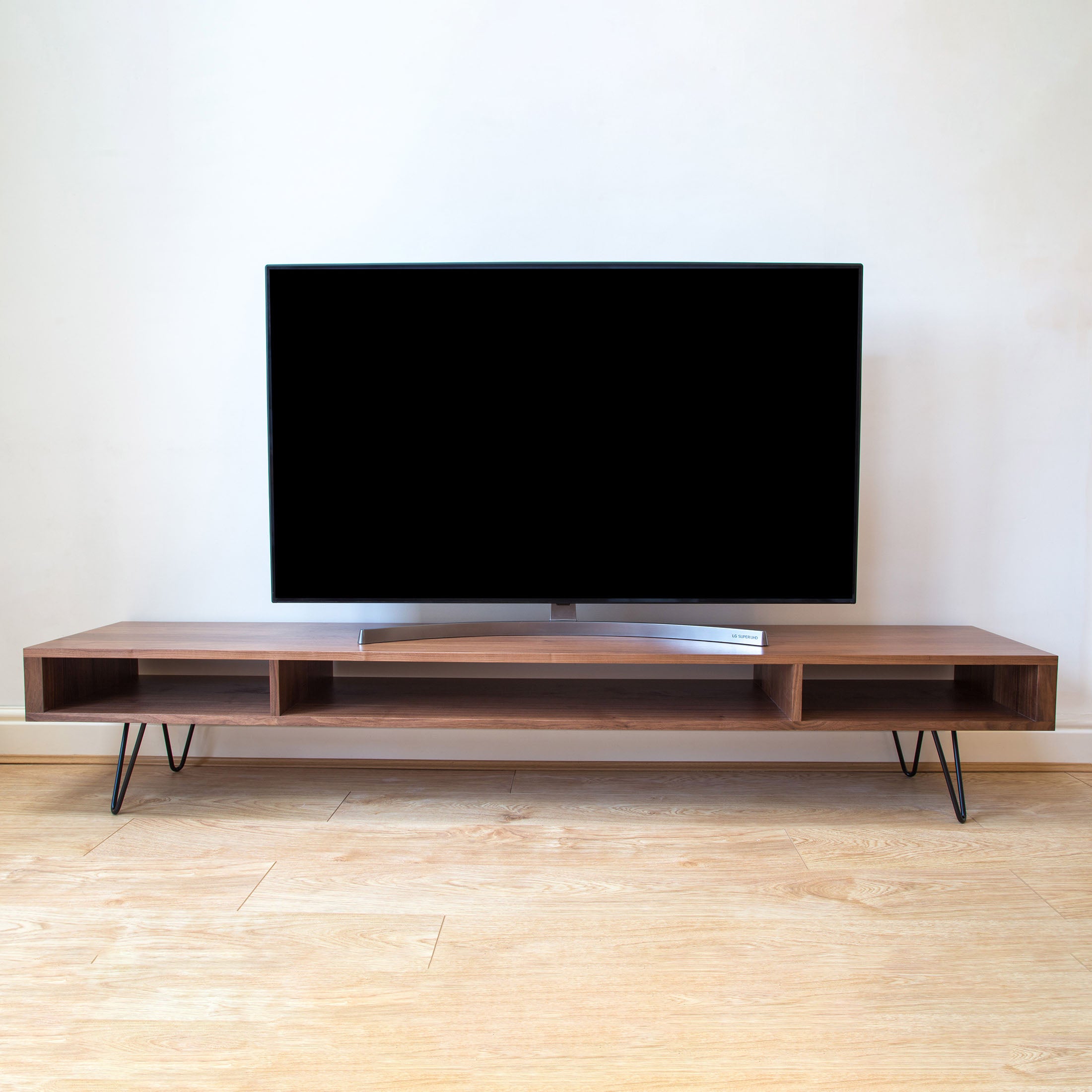
If you are considering a TV stand for vinyl, apply the same checks rather than relying on its media-furniture label. A compartment designed for a low amplifier may lack the height for upright LPs, and a cable opening does not establish adequate depth.
Samples and customisation
Once the dimensions work, compare wood samples beside your flooring and other furniture. View them in daylight and under your evening lamps; the same brown finish can look noticeably different between those settings.
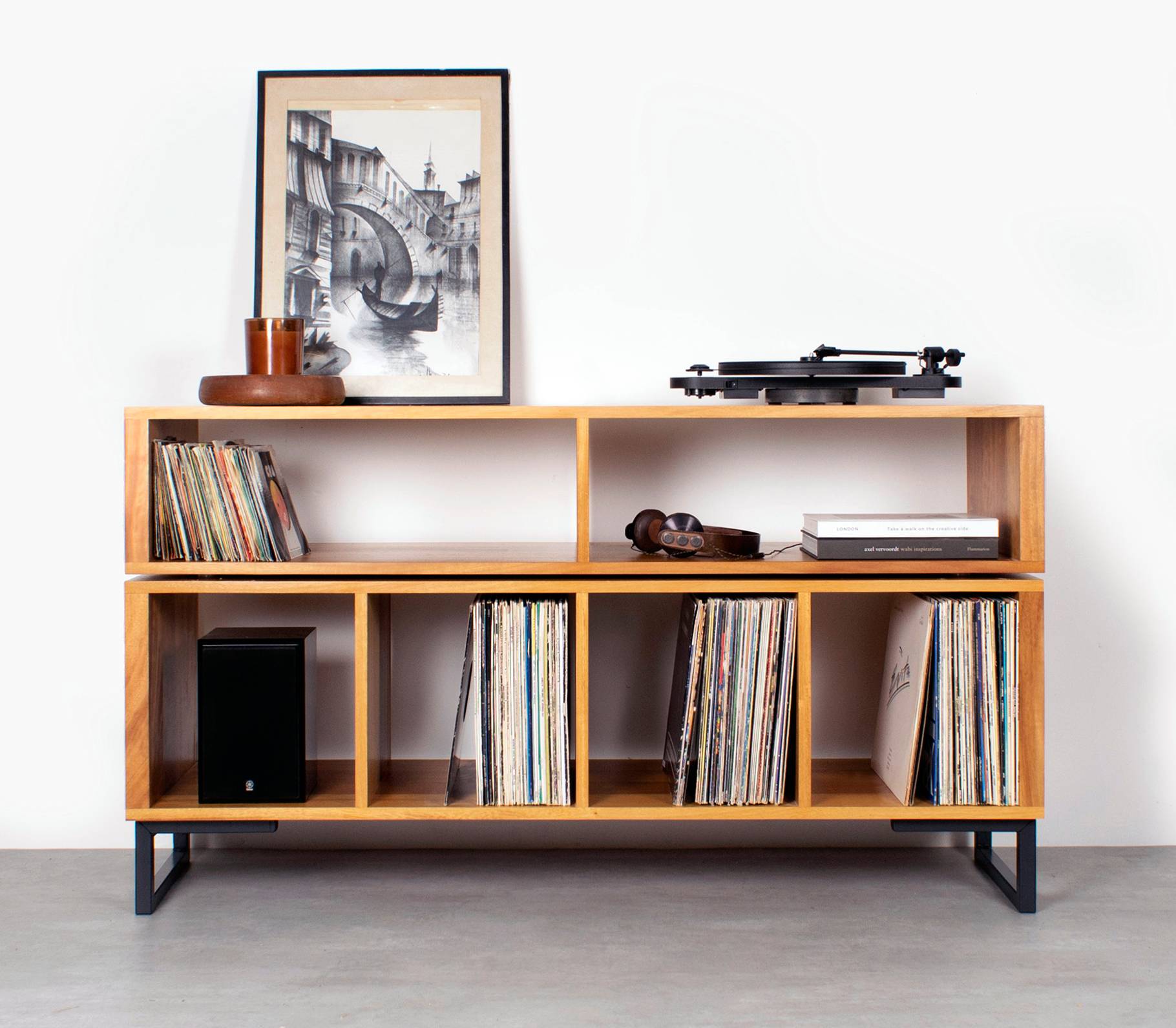
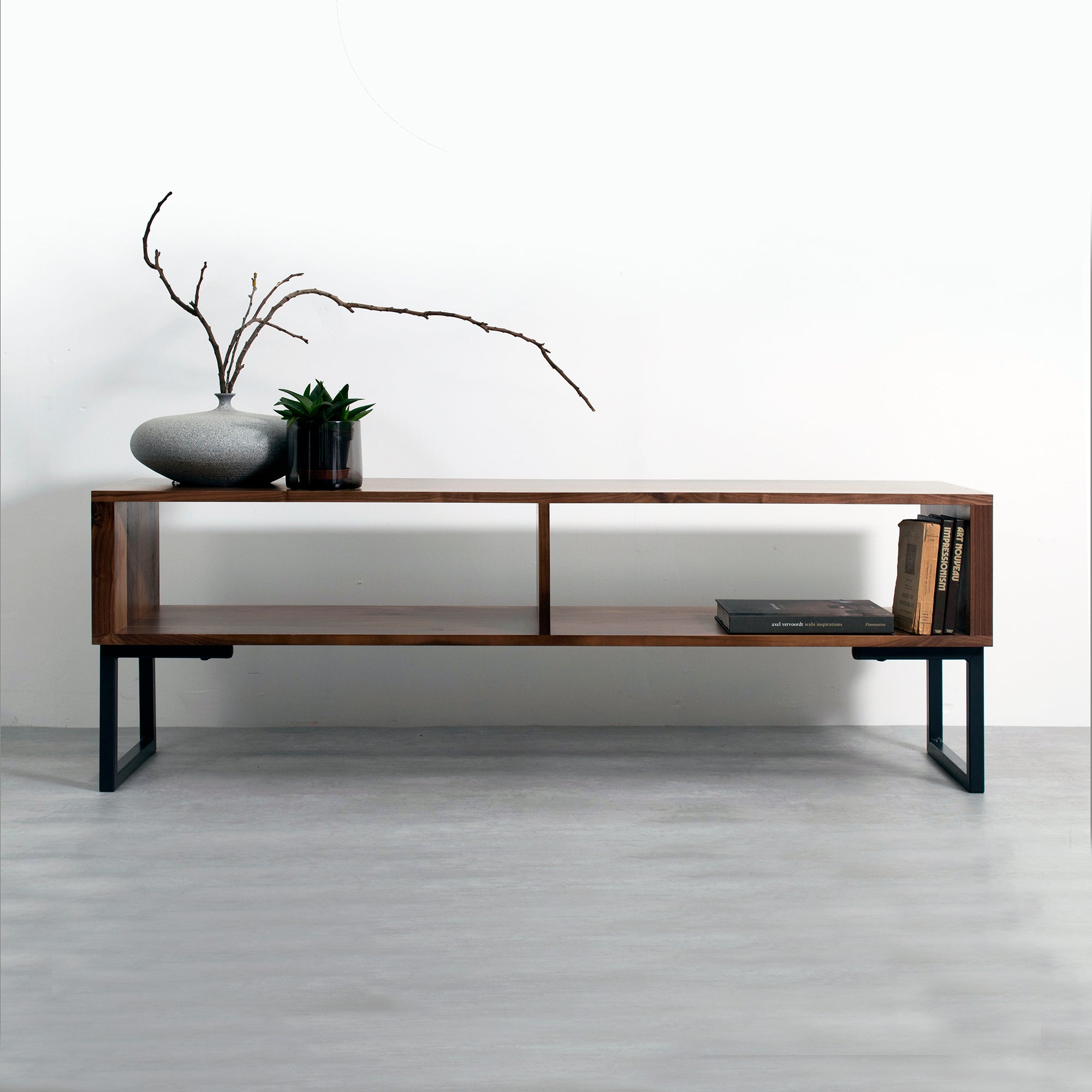
At Urban Editions, we offer wood samples and customisable, built-to-order hardwood furniture. Browse our solid hardwood vinyl storage and media units with your measurements to hand, so the finish and size choices follow the collection you need to accommodate.
Specify requirements in millimetres where a close fit matters. An 800 mm outside width and 800 mm of usable record space describe different pieces of furniture. Keep that distinction clear in your order details.
Conclusion
Measure one representative run of records, your largest sleeve and your turntable before choosing a cabinet. Those three measurements will narrow the options quickly. Choose the lower leg option for a deliberately low arrangement, or raise the cabinet when easier standing access matters more. Let the verified capacity and assembled strength decide what works; let the hardwood and hairpin proportions decide which suitable design belongs in your room.
Frequently Asked Questions
How many records fit in a mid-century vinyl cabinet?
Capacity depends on clear internal shelf width and sleeve thickness, not the cabinet’s outside width. At approximately 3 mm per sleeved LP, 30 cm holds about 100 records. Thick gatefolds and box sets reduce that number, so measure a mixed section of your collection.
Are hairpin legs strong enough for a full record collection?
Yes, when the assembled cabinet is designed and rated for the total load. A per-leg strength claim does not establish the capacity of the shelves, base or fixings. Choose using the whole-cabinet rating and the limits for each loaded shelf.
Which hairpin leg height should I choose?
Choose the height that puts the finished cabinet and turntable at a comfortable working level. Compare 10, 20 and 30 cm legs using the actual cabinet body height. Taller legs improve access beneath the cabinet but do not create more record storage inside it.
Can I store records flat if they do not fit upright?
Choose a different compartment rather than using flat stacks for long-term LP storage. Upright storage with proper side support makes records easier to retrieve and avoids placing the weight of a pile on the sleeves below. Keep occasional oversized releases in a suitably sized separate bay.