November SPECIAL OFFER! Sign-up to our newsletter to receive the latest offers and news.
TV Stand and Coffee Table Set: How to Match Wood, Height and Style
A coffee table sitting 2.5–5 cm below your sofa seat gives you a useful starting point, but your TV stand needs its own height. A TV stand and coffee table set should coordinate rather than match exactly: connect the pieces through wood undertones, leg shapes or finish, then size each independently. Set the coffee table by the sofa and the TV stand by comfortable seated viewing.
That approach gives you more freedom without making the room feel disconnected. Check wood samples together in daylight and evening lighting before choosing, because two finishes that look similar on screen can look quite different beside your sofa.
Key Takeaways
Coordinate one visible detail; size each piece independently.
Match wood undertones, not just species names.
Compare samples in daylight and evening lighting.
Set coffee table height from your sofa seat.
Use actual television width, not its diagonal screen size.
Leave comfortable space for reaching, walking and opening storage.
Should the two pieces match?
No, your coffee table and TV stand do not need to match. They need a clear relationship, which can be as simple as warm-toned wood or similarly tapered legs. A matching set is useful when both pieces already suit your room; coordinated separates give you more control over dimensions and storage.
A coordinated set is two independently useful pieces connected by a shared visual detail.
Start with the piece you are keeping, or the one with the least flexible requirements. That is often the TV stand, because it needs to accommodate a particular television, media equipment and wall space. Choose the coffee table around your sofa rather than forcing it to follow the cabinet’s dimensions.
The main objection to coordinated separates is understandable: will they look as though they belong together? They will when you repeat one clear feature and make the differences deliberate. Pale oak and dark walnut create a readable contrast; two nearly identical brown finishes can look like an unsuccessful attempt to match.
We recommend choosing the shared feature before browsing. Write down something specific, such as “warm wood with slim legs”, rather than a broad label like “modern”. That small decision keeps an attractive but unrelated piece from steering the whole room.
Match wood undertones, not exact colours
You can mix different wood tones successfully by keeping their underlying colour compatible. Undertone means the yellow, orange, red or grey cast beneath the main colour. A pale surface and a dark surface can share warmth even when their overall colours are quite different.
Colour and grain
Look at the largest wood surface already in your room. An exposed timber floor often sets the direction; with a large rug, the TV stand might become the strongest wood feature instead. Use that surface as your reference rather than assessing two new pieces in isolation.
Then compare grain, the visible pattern in the wood. Oak and ash often have pronounced grain, while walnut commonly brings deeper brown colour and flowing patterns. Iroko usually has warm golden-brown colouring and can darken with age. These are starting points, not promises about every board.
The same species will not produce an identical colour across different pieces. Natural variation, the boards selected and the finish all affect the result. A wood name is not a colour specification.
Three useful pairings
These illustrative combinations show how contrast can work without adding lots of unrelated finishes.
TV stand wood
Coffee table wood
Shared feature
What to compare on samples
Natural oak
Walnut
Warm undertones with light–dark contrast
Whether the oak looks golden beside the walnut
Ash
Natural oak
Pale colouring and visible grain
Whether one finish looks grey and the other strongly yellow
Iroko
Walnut
Warm brown tones
Whether the iroko’s golden colour suits the walnut’s deeper brown
Oak and walnut make a useful pairing when you want a darker focal point without darkening every surface. Ash and oak keep the contrast quieter, so differences in undertone become more noticeable.
With iroko and walnut, use the room’s lighter surfaces to balance the deeper colours. A pale rug can separate a dark coffee table from a dark floor without introducing another wood.
Finish matters
A matt or low-sheen finish reflects less light than a glossy surface. That difference changes how strongly each piece catches your attention, even when the woods have similar colouring.
Choose a similar level of sheen for a calm relationship. If one piece has a visibly textured grain and the other looks smooth, connect them through their colour or legs rather than trying to repeat every surface detail.
Test samples where the furniture will live
Compare wood samples in the actual living room, both during daylight and under the lamps you normally use. Product photographs help you narrow the choice, but they cannot show how your wall colour, flooring and lighting will affect the finished appearance.
Daylight checks
Place the samples together near the proposed furniture positions, then look at them beside the floor and sofa. Hold them in the orientation of the finished surface: flat for a tabletop, upright for a cabinet front.
Use a plain white sheet of paper beside them to make subtle yellow, pink or grey casts easier to notice. Move away from a bright window as well; a finish that looks pale in direct light can feel much darker across the room.
At Urban Editions, we offer wood samples so you can compare your preferred hardwoods at home before choosing your furniture. Use them to settle the pairing, rather than relying on two separate screen images.
Evening checks
Repeat the comparison with your normal evening lighting. A lamp rated around 2,700 K gives warm light, which can make golden tones more noticeable than they appear in daylight.
Keep both samples under the same light while comparing them. Looking at one beside a lamp and another in shadow creates a difference that belongs to the lighting, not necessarily the wood.
Give this check a full day-and-evening cycle. A little patience here is easier than trying to correct an awkward pairing with accessories afterwards.
Set each height from how you use it
The coffee table should sit around sofa-seat height or slightly lower. The TV stand should place the screen at a comfortable seated viewing height. There is no benefit in making both surfaces level if doing so leaves you reaching awkwardly or looking upwards.
Coffee table height
Measure from the floor to the top of the sofa seat cushion. If your sofa seat is 45 cm high, a coffee table around 40–45 cm gives you a sensible selection range, with the lower end creating a more relaxed profile.
Check the relationship while sitting down, especially with deep or soft cushions. A sofa that looks fairly upright when empty can leave you sitting much lower once the cushions compress.
The useful test is reaching for a mug without lifting your shoulder or leaning heavily forward. Choose closer to seat height if easy access matters most. Choose slightly lower if you prefer an open view across the room and the surface remains comfortable to reach.
Avoid selecting an unusually low table purely because it suits the TV stand’s proportions. A table designed for a low lounge sofa can feel awkward beside a higher, firmer seat.
TV stand height
Sit in your normal viewing position and measure your eye height from the floor. Use that as the starting point for positioning the television’s centre near your seated eye level, then test the position against your usual posture.
For example, take a seated eye height of 105 cm and a television body about 71 cm high. Its centre is 35.5 cm above its lower edge, so the lower edge would sit about 69.5 cm above the floor. If the television’s feet raise that edge 6 cm above the cabinet, a cabinet around 63.5 cm high places the screen centre at that eye height.
Those figures are an illustration, not a universal cabinet recommendation. Your sofa, television feet and viewing posture determine the result.
Mark the proposed screen outline on the wall with low-tack tape. Watch from your normal seat for several minutes rather than judging it while standing. If you recline regularly, test that position too.
A wall-mounted television separates screen height from cabinet height. In that arrangement, choose the cabinet for storage and proportion, while keeping enough space for any equipment sitting on top.
Size for the screen, sofa and walking routes
Choose the TV stand width from the television’s actual width, then choose the coffee table length from the sofa and available floor space. The two pieces do not need equal lengths or matching footprints to look balanced.
Width and length
Televisions are sold by diagonal screen size, not cabinet width. A 65-inch television with a standard 16:9 screen is about 144 cm wide, before allowing for its frame.
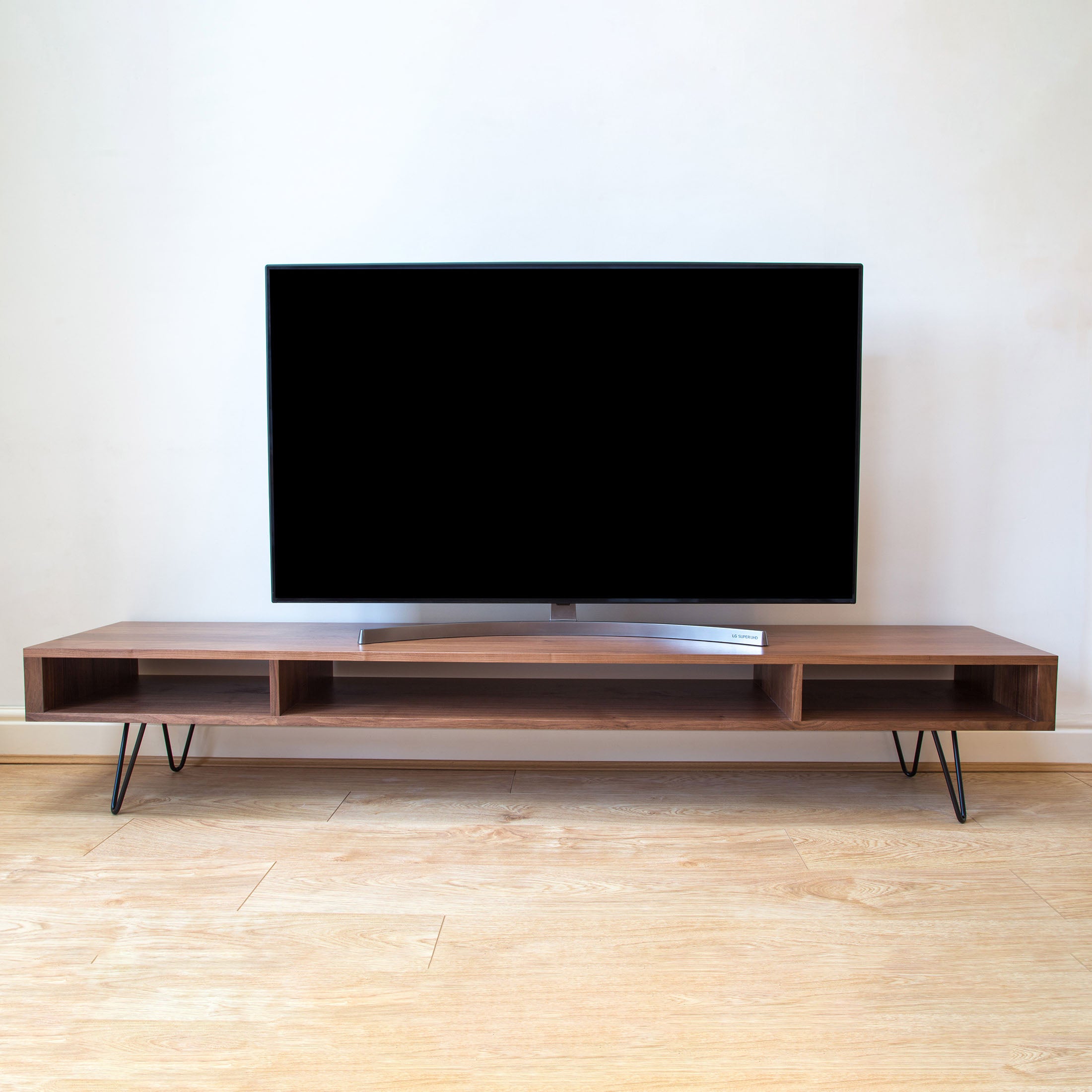
For that television, a stand around 160–180 cm wide gives approximately 8–18 cm of visible surface at each side. That creates a more settled appearance than a cabinet barely wider than the screen. Confirm that the television’s feet fit fully on the top in both width and depth.
For the coffee table, start at roughly two-thirds of the sofa’s length. A 210 cm sofa therefore suggests a table around 140 cm long. Treat that as a proportion guide: a chaise, doorway or narrow room can make a shorter table the better choice.
Depth deserves equal attention. Measure your largest media component, including plugs and cable bends, rather than assuming it will fit because the cabinet looks substantial.
Reach and circulation
Leave about 40–45 cm between the sofa and coffee table as a practical starting point. This gives you room for your legs while keeping the surface within reach.
A main walking route needs more space. Aim for roughly 75–90 cm where people regularly pass between furniture, and use the wider end where the room allows.
For example, imagine 180 cm between the sofa front and the TV stand. Allowing 45 cm beside the sofa and an 80 cm walking route leaves 55 cm for coffee table depth. The result is a table no deeper than about 55 cm in that layout.
Check the space with storage open. A cabinet door or drawer can temporarily occupy the very route that looked generous on your floor plan. In a compact room, that can make a shallower table more useful than a longer one.
Connect minimalist and mid-century styles
A minimalist coffee table can work comfortably with a mid-century TV stand when they share a restrained outline, compatible wood or related legs. Let one piece carry the stronger design detail while the other gives it space.
Leg language
Mid-century furniture often uses tapered legs, sometimes angled outwards. Minimalist furniture usually reduces visible detail and keeps the overall shape simple. Those approaches overlap more than their labels suggest.
Pair a cabinet on tapered legs with a table on slim, straight legs if both have light, uncluttered bases. The leg shapes do not need to be identical; their thickness and the amount of visible floor beneath them can provide the connection.
If you already have several angled chair legs in the room, a simpler table base gives your eye somewhere to rest. Repetition works best when it is selective.
Visual weight
Visual weight describes how heavy or substantial an object appears. A dark cabinet with closed storage looks heavier than a pale table with an open base, even when their outer dimensions are similar.
Use that difference deliberately. A broad, enclosed TV stand often works well with a coffee table that leaves more floor visible. This balances the room without requiring a tiny tabletop.
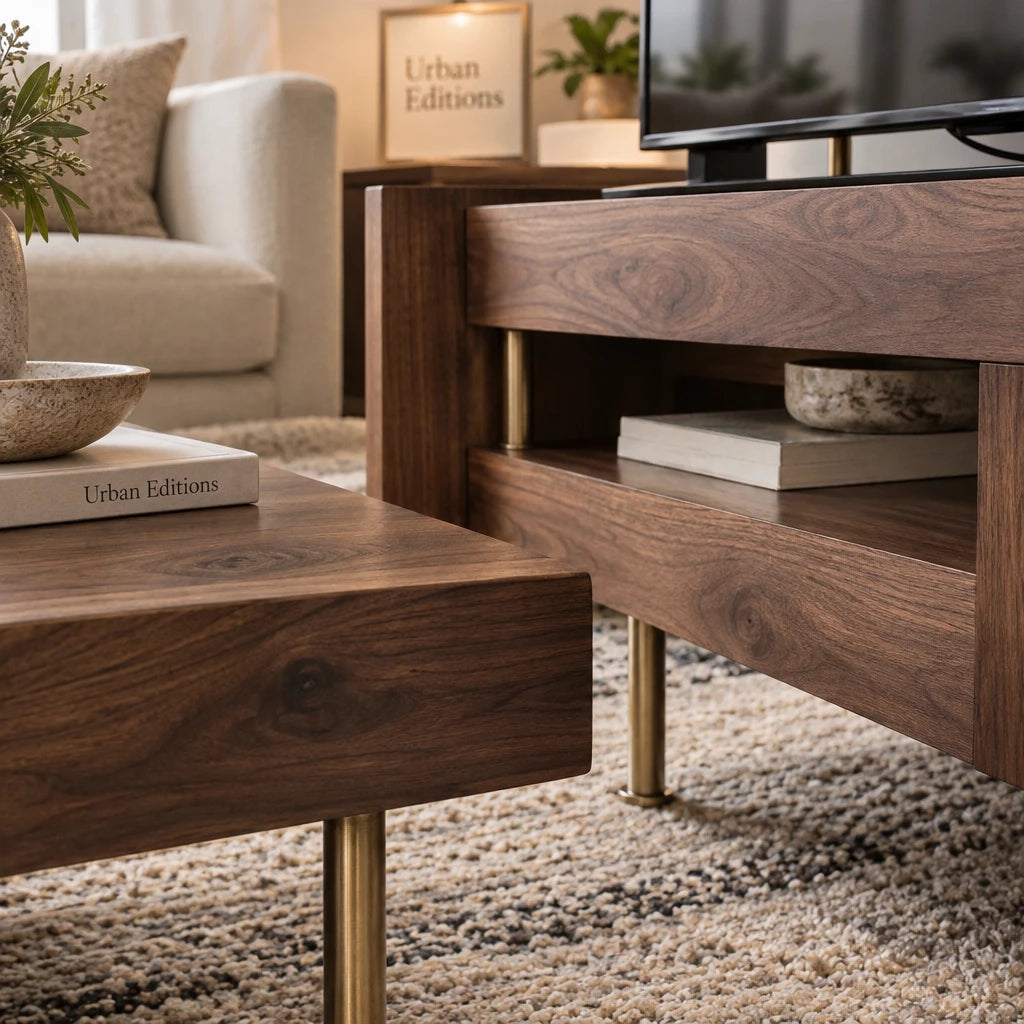
For example, a walnut cabinet with flush doors and tapered legs can sit alongside a plain oak table with slim legs. The warm undertones and open bases connect them; the lighter tabletop prevents the centre of the room feeling crowded.
Keep accessories quieter when both pieces have strong grain. You do not need matching handles, edge profiles, corners and legs as well. Family resemblance, if you will.
Finish with a measurement-and-sample check
Before ordering, bring the dimensions and wood choices together in one place. A convincing colour pairing is only useful if you can reach the table, watch comfortably and move through the room.
Use this sequence to turn your preferences into a workable shortlist:
Record the fixed dimensions. Measure the sofa seat height and length, television body, feet and available wall width.
Set the two heights independently. Choose the coffee table from your seat height and position the television from your seated eye level.
Tape out both footprints. Include the full coffee table depth and the TV stand’s position against the wall.
Test everyday movement. Sit down, reach forward, walk past and allow room for cabinet doors or drawers to open.
Compare samples together. Review them beside your floor and sofa through one daylight-and-evening cycle.
Name the shared detail. Confirm whether undertone, finish or leg style is doing the work of connecting the pieces.
With those measurements recorded, browse our solid wood TV stands against your required width, height and storage needs. Keep only the designs that fit those requirements before comparing their appearance with your coffee table choice.
For built-to-order furniture, distinguish the dimensions you need from those you simply prefer. A required equipment depth is fixed; an extra few centimetres of tabletop length may be negotiable.
Conclusion
Put your shortlisted wood samples beside a taped outline of each piece before making the final choice. If the colour relationship works but the room feels tight, change the dimensions rather than abandoning the pairing. If the sizes work but the woods compete, keep the shapes and choose a different finish. This gives you one clear adjustment at a time, rather than starting again.
Frequently Asked Questions
Should a coffee table be lower than the TV stand?
A coffee table does not need to be lower than the TV stand, although it often is. Judge the table against your sofa and the cabinet against the television’s viewing position; matching their heights offers no practical advantage.
Can you mix oak and walnut furniture in a living room?
Yes, oak and walnut work well together when their undertones are compatible. Compare actual finish samples rather than relying on species names, and use the lighter and darker woods deliberately instead of trying to make them look identical.
What if my wood floor clashes with the coffee table?
Choose a table with a more compatible undertone, or use a rug to create a clear break between the surfaces. A rug is especially useful when the colours are close but the grain patterns compete; compare the rug and wood samples together.
Can a round coffee table work with a rectangular TV stand?
Yes, a round coffee table can soften the long horizontal shape of a rectangular TV stand. It also removes projecting corners from the centre of the seating area, but check its full diameter against your walking routes before choosing it.