October SPECIAL OFFER! Sign-up to our newsletter to receive the latest offers and news.
Vinyl Storage Furniture: Sizes for Every Collection
12 inches is the dimension that controls your vinyl storage furniture. A standard LP sleeve needs upright space for its height, plus enough depth to avoid crushed corners and awkward handling. Choose a cabinet around today’s record count alone and you can soon face crowded shelves, poor access or a turntable perched on an unsuitable surface.
The right unit gives your collection room to grow while keeping your record player, amplifier and accessories comfortable to use. You need to measure the records, the equipment and the available floor area together.
Key Takeaways
12-inch records need upright, accessible storage
Allow roughly 15–20% capacity for collection growth
Measure depth, cables and clearance, not width alone
Keep the turntable at a comfortable operating height
Modular storage works best for expanding collections
Start with the Record Count, Then Add Growing Room
A practical starting point is to count your records and allow space beyond the current total. For example, a collection of 80 LPs should not fill a shelf designed for exactly 80. Aim for roughly 15–20% spare capacity, giving you room for about 12–16 additional records without forcing sleeves tightly together.
How much space does one record need?
A 12-inch record sits inside a sleeve that is usually close to 31–32cm square. The exact size varies between pressings, gatefold sleeves and box sets, so a cabinet should provide slightly more internal height and depth than the bare record dimensions.
For planning purposes, allow around 2.5–3cm of shelf width per record. A single 80-record row therefore needs approximately 200–240cm of linear space, depending on sleeve thickness. This is a planning estimate rather than a fixed rule; heavy gatefold albums consume more room than single-disc sleeves.
Upright storage keeps the weight of neighbouring records off the disc and reduces the risk of bent sleeves, trapped dust and difficult browsing.
Store vinyl upright, like books. Flat stacks put pressure on the records at the bottom and make it harder to remove one album without disturbing the rest.
A useful capacity guide
The table below gives a sensible starting point for standard LPs. It assumes upright storage and average sleeve thickness, not a tightly packed shelf.
Collection size
Suggested capacity
Practical furniture format
Spare room
30–60 records
70–80 records
Compact cabinet or turntable stand
10–20 records
80–120 records
140–160 records
Two-bay cabinet or larger media unit
20–40 records
150–250 records
280–320 records
Wide cabinet or modular storage
30–70 records
300–500 records
550–600 records
Several modules or a dedicated wall unit
50–100 records
These figures make the main point clear: buy for the next stage of your collection, not only its present size. A small-looking cabinet often becomes the more expensive option when you replace it after a year.
You should also account for double albums, 12-inch singles, picture discs and boxed editions. If your shelves contain many gatefold releases, reduce the expected capacity and choose a deeper or wider design.
What Furniture Dimensions Work for 12-Inch Records?
For 12-inch records, prioritise internal clearance before external width. A useful unit needs enough height for the sleeve, enough depth for safe insertion and enough open space around the cabinet for your hand to grip the record. Measure the internal compartment, not only the advertised outside dimensions.
Width and shelf planning
A 60cm-wide compartment might hold roughly 20–24 average LPs, while a 90cm compartment could hold around 30–36. These are working estimates based on 2.5–3cm per record. A tightly compressed row is harder to browse and puts unnecessary pressure on sleeves.
Divide a large collection into manageable bays rather than creating one very wide opening. Two 60cm compartments are often easier to load, reinforce and use than one 120cm shelf. The split also gives the furniture a cleaner visual rhythm.
Depth and clearance
Allow at least a few centimetres beyond the sleeve depth for your fingers. A cabinet that fits a 31cm sleeve exactly leaves no room to pull the record forward safely. The back panel, cable channels and any front frame can reduce usable depth.
Measure skirting boards, sockets and nearby furniture before ordering. A unit that is 40cm deep may fit the records comfortably but project too far into a narrow walkway. Leave a clear route to seating and make sure doors or drawers can open fully.
Height and access
The most comfortable record storage places frequently played albums between knee and shoulder height. Floor-level compartments hold more weight but require bending, while very high shelves make browsing awkward and increase the risk of dropping a record.
For a turntable stand, consider the combined height of the furniture and deck. Your operating position should let you lift the tonearm without leaning across the platter. A low coffee-table height may suit storage, but it is usually poor for regular record handling.
Furniture dimensions affect listening habits.
A made-to-order unit lets you match the storage width, shelf arrangement and overall height to the room. The Urban Editions designs and makes solid hardwood furniture in the UK, with customisable designs and wood samples available when you need a closer fit.
Turntable Placement Needs More Than a Flat Top
A turntable needs a stable, level surface with enough room to operate the lid, cue the tonearm and connect the cables. Do not assume every media unit can safely support a deck and hi-fi equipment simply because its top looks wide enough. Turntable clearance is part of the storage calculation.
Leave operating space around the deck
Measure the turntable footprint, then add room for your hands and any hinged dust cover. A deck measuring 45cm wide may need a surface closer to 60cm wide once you allow space for controls and cable routing.
Keep the front edge clear. If the turntable sits flush with the cabinet edge, your hand may strike the furniture when you cue a record. Leave space behind the deck for signal and power cables without forcing sharp bends.
Plan the full hi-fi stack
Amplifiers generate heat and need ventilation. A receiver or integrated amplifier may be deeper than the turntable, while a separate phono stage adds another box. Check each component’s width, depth and height before selecting a shelf.
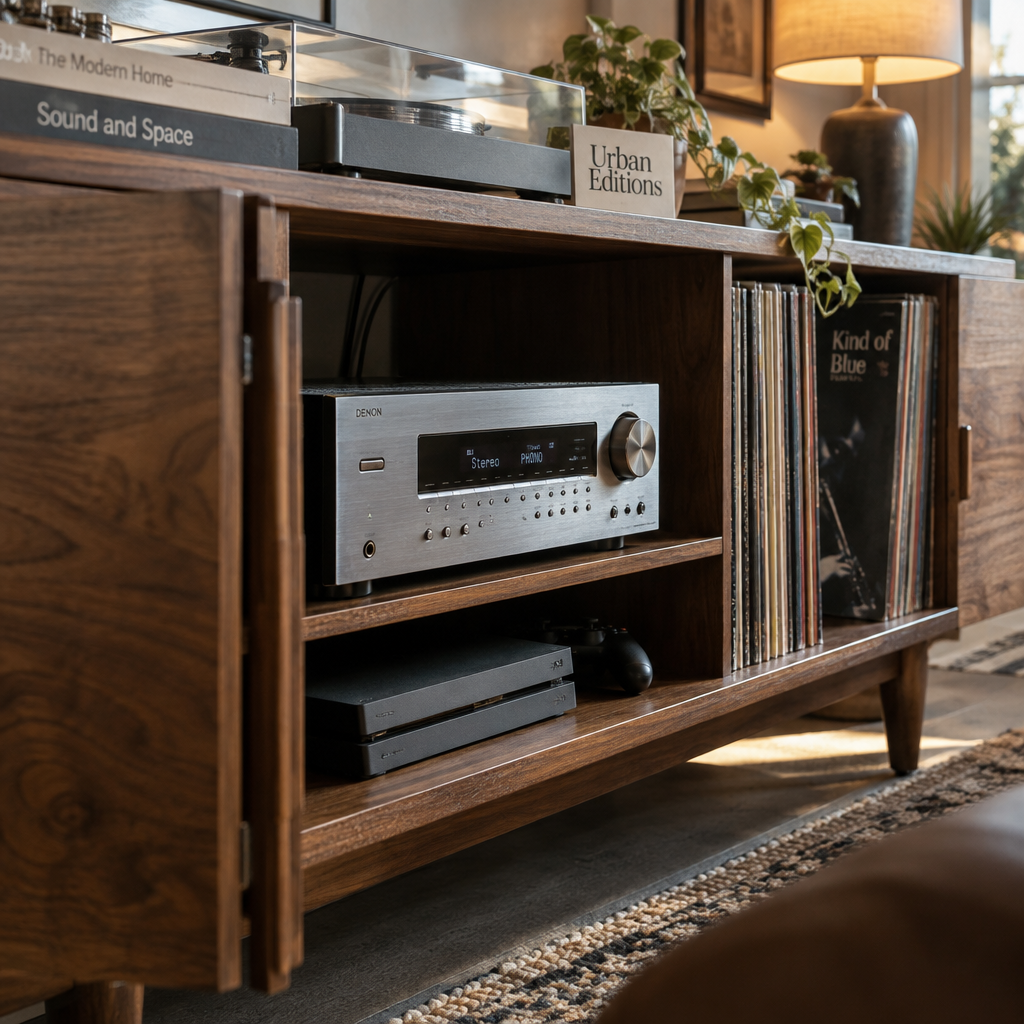
Avoid placing a heavy amplifier on a shallow record compartment unless the furniture is designed for that load. The equipment should sit on a properly supported surface, with ventilation around heat-producing components. Keep speakers separate where possible, because vibration can affect playback.
Choose a layout that matches the room
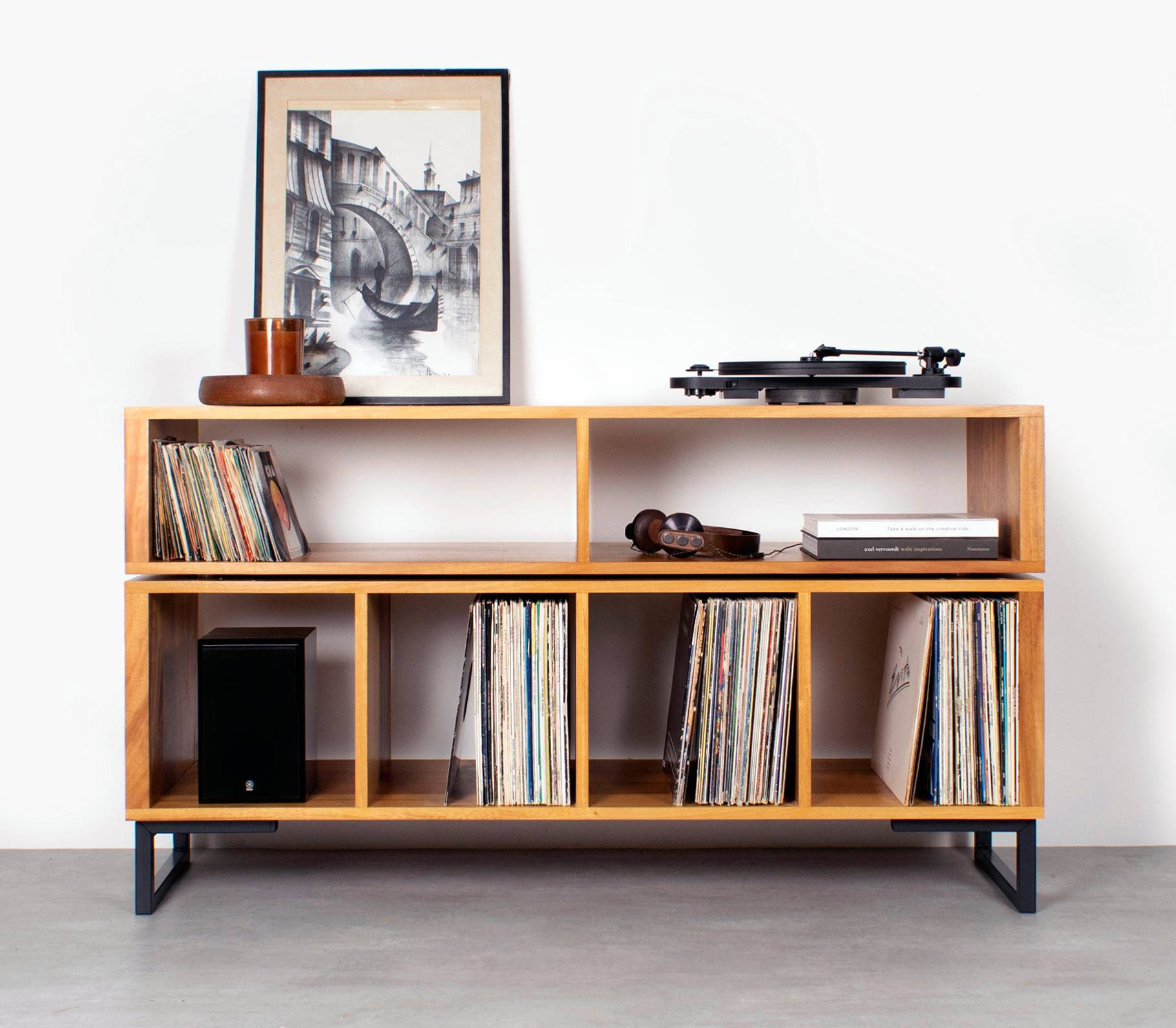
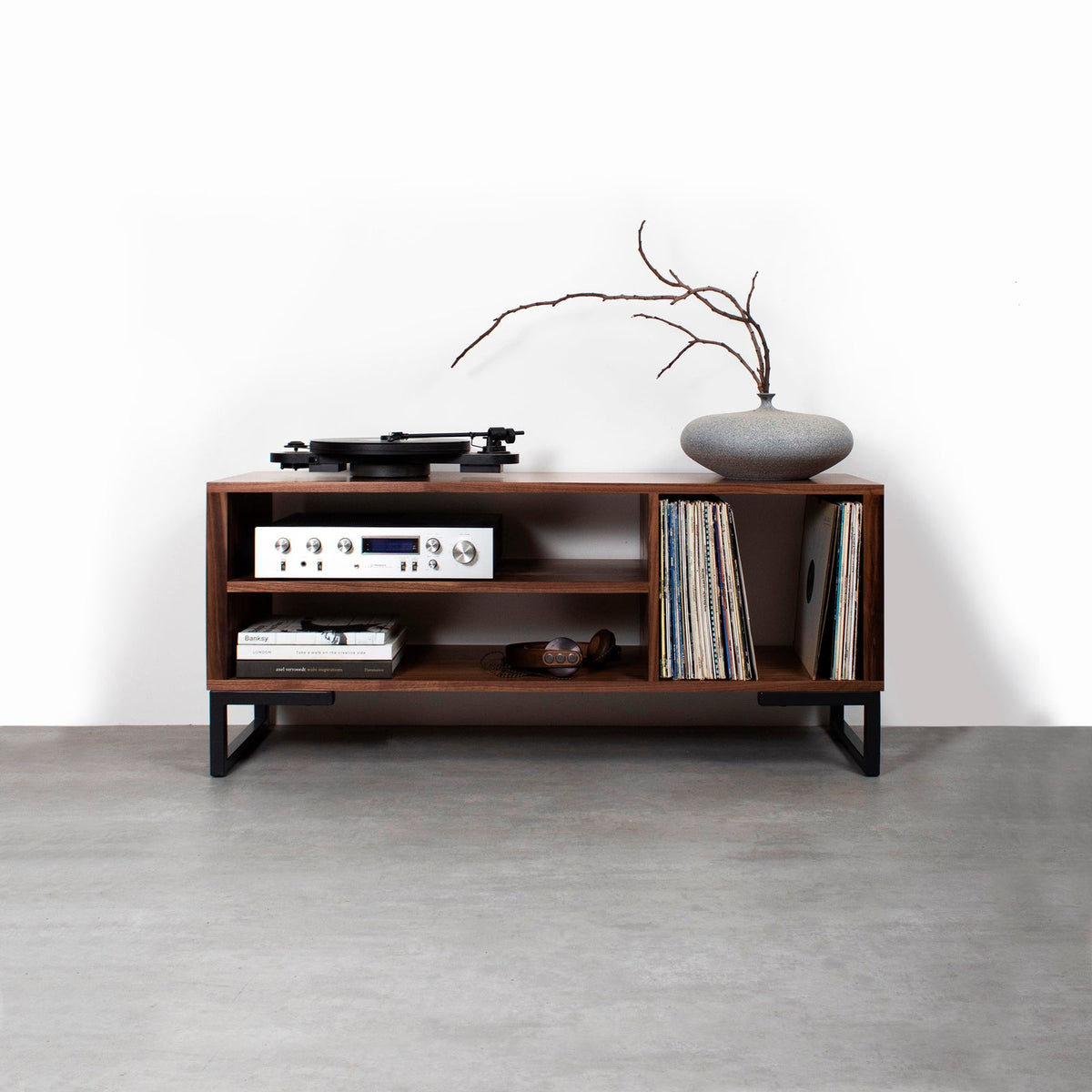
A narrow turntable stand suits a small collection and a compact listening corner. A wider media unit works better when the deck, amplifier and records need to sit together. For a larger collection, split the system across a central equipment surface and side storage rather than creating one overloaded cabinet.
You can compare different turntable and storage layouts in the media unit collection before deciding how much of the wall your system should occupy. Look at the full arrangement, including seating, speaker position and access to sockets.
Use this sequence before ordering:
Measure the turntable, amplifier and any separate audio components.
Mark the equipment footprint on the floor with masking tape.
Add clearance for lids, cables, ventilation and hand access.
Measure the record collection and add 15–20% growth space.
Check skirting boards, sockets, door swings and walking routes.
Confirm the furniture’s stated dimensions and internal storage layout.
A unit can look generous in a product photograph yet feel cramped once the dust cover is open. Test the footprint on the floor first, especially in a room under 12 square metres.
Which Size Suits a Small or Large Vinyl Collection?
Choose a compact cabinet for fewer than 100 records only when it leaves operating space around the turntable and a clear route through the room. For 100–250 records, a two-bay unit is usually the best balance. Above 250 records, use wider modular storage or separate equipment from the main collection.
Small collections: up to 100 records
A collection of 40–80 records can fit neatly in a compact turntable stand or low cabinet. Choose a unit with capacity for around 70–100 records rather than filling every centimetre on day one. The spare space makes browsing easier and prevents the cabinet from looking overpacked.
Small collections still need proper depth. A narrow unit designed for books may accept the record height but fail to support the sleeve depth. Look for furniture designed around 12-inch records, not generic shelving.
Medium collections: 100–250 records
Once your collection passes 100 records, a single narrow stand often creates poor access. A two-bay cabinet gives each row a manageable width and leaves space for future purchases. It also allows you to arrange records by genre, artist or listening frequency.
At this size, consider the relationship between storage and equipment. A 140-record cabinet with a central turntable surface can work well in a living room, but only if the amplifier has adequate room and the speakers are not trapped beside the furniture.
Large collections: 250 records and above
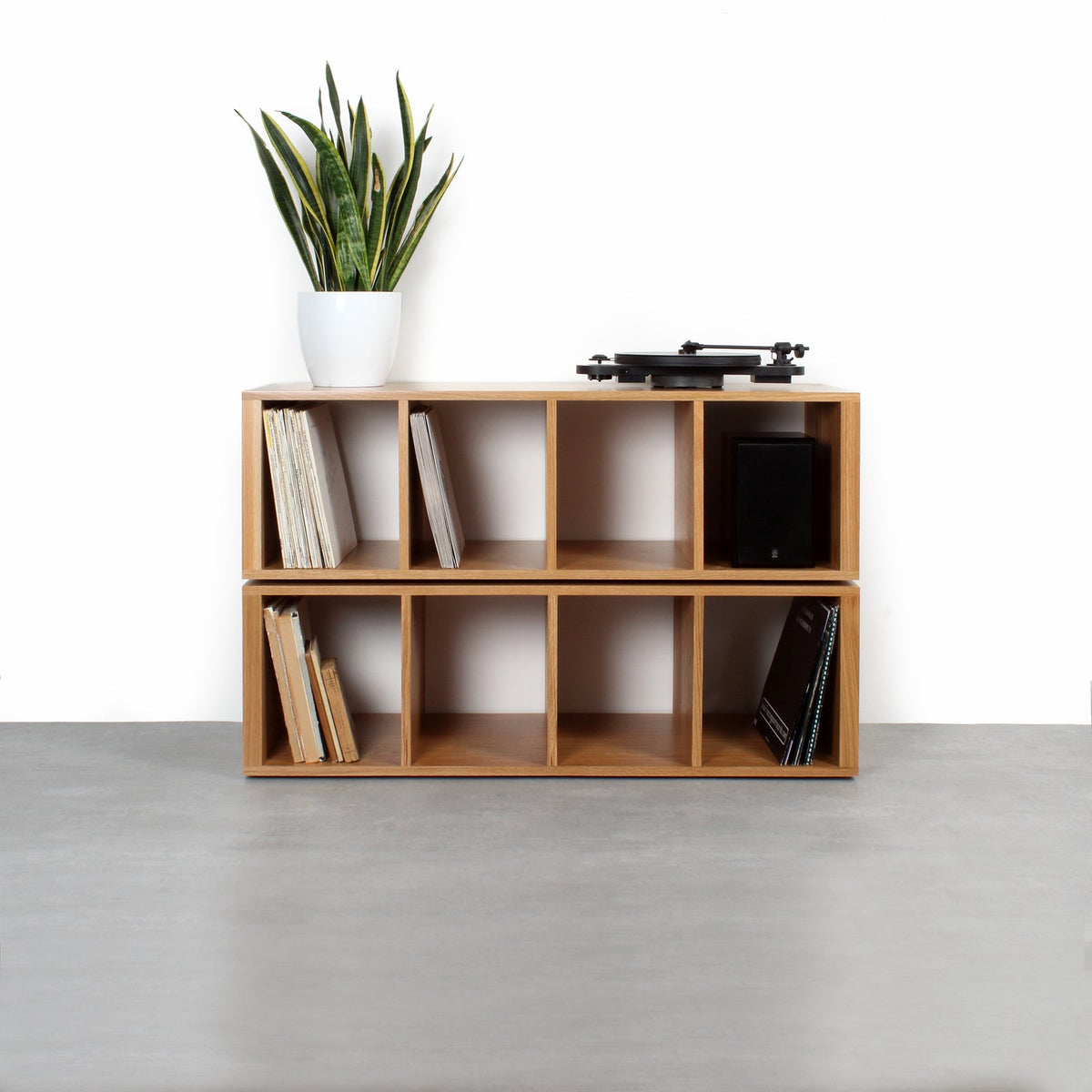
Large collections need a storage plan rather than one oversized box. Divide the records into modules, keeping frequently played albums closest to the main listening position. Modular storage also lets you add a second unit later without replacing the first.
A 300-record collection may need around 360 spaces if you want 20% growth capacity. Gatefold albums and boxed sets could push that requirement higher. Count the thickest part of your collection, not only the number of discs.
The main drawback is visual scale. A wide wall unit can dominate a smaller sitting room, while several smaller cabinets may cost more overall. I recommend modular solid hardwood storage when your collection is growing quickly, because you can expand in stages and keep each section easier to move and use.
Modular Storage Makes Collection Growth Easier
Modular vinyl storage furniture is the strongest choice when your collection grows at an uncertain rate. It lets you start with a practical cabinet and add matching storage later, instead of buying a wall-sized unit that leaves unused space. Design the first module around the room’s permanent features, including sockets, radiators and door openings.
Build around fixed room dimensions
Measure the wall from skirting board to skirting board, then subtract the space needed for curtains, sockets and ventilation. In a rented flat, leave enough flexibility to move the furniture through doorways and up stairs. A 90cm-wide module is easier to handle than a single 180cm cabinet.
Check lift access and stair turns before commissioning large furniture. The room may accept the finished unit while the building entrance does not. This edge case matters in Victorian terraces and upper-floor flats with narrow staircases.
Match modules by finish and proportion
Different wood species change the visual weight of the furniture. Oak gives a lighter, more familiar appearance, while walnut creates a deeper tone. Ash and iroko offer further options when you want the cabinet to relate to flooring, shelving or other hardwood pieces.
Keep module heights and plinth lines consistent. Mismatched heights make an expanding collection look accidental, even when every unit has good storage. Ask for wood samples before ordering if the cabinet will sit beside an existing desk or TV stand.
Leave a planned expansion point
Do not place the first cabinet tightly between a wall and a radiator if you expect to add another section. Reserve one side for growth and keep the expansion route clear. A spare 60cm of wall can make the difference between a simple addition and a complete furniture rearrangement.
Built-to-order furniture works well when standard dimensions leave awkward gaps. The Urban Editions range uses sustainably sourced solid hardwoods including oak, walnut, ash and iroko, and furniture is made in a family-run UK joinery. That gives you a route to a considered size rather than forcing the room around a mass-produced unit.
A collection grows in irregular jumps. One record fair visit can add 20 albums, while a quiet month adds none, so capacity should be treated as a moving target rather than a final measurement.
Solid Hardwood Storage: Weight, Access and Long-Term Use
Solid hardwood is a strong choice for vinyl storage when you want furniture that remains part of the room for years. It gives the cabinet a substantial feel and suits minimalist or mid-century interiors, but the material does not remove the need for sound dimensions, support and careful placement.
Support the load correctly
Vinyl is heavy. A row of 100 records can weigh a substantial amount once sleeves and inner bags are included, and a cabinet holding several rows carries that load over a small footprint. Shelves need suitable support across their span, especially when the unit also carries a turntable or amplifier.
Do not fill a shelf beyond its intended layout simply because the records fit. Crowding increases handling force and makes the furniture harder to use. The cabinet should support the collection while allowing each record to slide out without dragging its neighbours.
Protect the records during everyday use
Keep the furniture away from direct heat sources and damp areas. A radiator, external wall with condensation or poorly ventilated alcove can create an unsuitable environment for paper sleeves and vinyl. Aim for a stable indoor room rather than a garage, shed or unheated loft.
Use inner sleeves and handle records by the edges and labelled area. Storage furniture cannot correct poor handling, but a well-sized upright compartment reduces the temptation to stack records on the floor or lean them at an angle.
Treat the cabinet as working furniture
A record cabinet should support a routine: selecting an album, opening it, placing it on the platter and returning it afterwards. If the storage is too low, too deep or blocked by a sofa, you will use it less efficiently. The best furniture makes the correct action easy.
Solid hardwood furniture costs more than flat-pack board furniture in many cases. That is the genuine drawback. You are paying for material, joinery and a longer-term piece, so confirm the dimensions and finish before ordering rather than relying on a quick visual match.
The Urban Editions furniture is designed and made in the UK, with free UK delivery and international shipping available. For a room with an unusual alcove or a collection between standard sizes, custom-sized hardwood storage such as the Technic vinyl storage cabinet gives you a practical starting point for specifying the fit.
A Simple Sizing Method for Your Room
The best size is the one that accommodates your records, equipment and movement without making the room feel blocked. Take measurements in centimetres and record them in one place. Guessing from a photograph is how depth and clearance problems begin.
Measure the collection
Count the records you own, then separate out box sets and unusually thick gatefold sleeves. Multiply the average shelf width per record by the number of albums, using 2.5–3cm as a starting estimate. Add at least 15% spare capacity for normal growth.
If your collection contains many double albums, use a larger allowance. A shelf planned for 100 standard LPs may hold fewer when a quarter of those records have gatefold sleeves.
Measure the equipment
Write down the turntable’s width, depth and height, then repeat the process for the amplifier and other components. Add room for the dust cover, tonearm operation and cables. Do not push the rear of the equipment against a wall simply to save a few centimetres.
Place masking tape on the floor to outline the proposed unit. Leave the tape in position while you walk past, sit down and reach towards the turntable. This quick test reveals blocked routes that a written dimension can miss.
Check the room before committing
Measure the wall, skirting board, sockets and nearby furniture. Check that drawers or doors have space to open. If the cabinet sits under a window, measure the sill height and confirm that the unit will not interfere with curtains or a radiator.
Use this decision guide:
Choose a compact stand for up to 100 records and a simple equipment setup.
Choose a two-bay cabinet for 100–250 records and a combined listening station.
Choose modular storage above 250 records or when growth is rapid.
Choose custom dimensions when alcoves, sockets or equipment sizes defeat standard furniture.
Your final measurement should include the space needed to remove a record. A cabinet that technically fits the wall but leaves no hand clearance is the wrong size.
Conclusion
Measure the records, the equipment and the room as one system. Choose upright storage with 15–20% spare capacity, then protect access around the turntable and amplifier. Pick modular furniture when growth is uncertain; choose a custom-sized solid hardwood unit when the room has awkward dimensions or your equipment needs a precise layout.
Frequently Asked Questions
How many records fit in a 60cm vinyl storage unit?
A 60cm compartment usually holds roughly 20–24 standard LPs when stored upright with comfortable browsing space. Capacity falls when the collection contains many gatefold sleeves, box sets or thick outer sleeves, so leave room rather than compressing the row.
Should vinyl records be stored flat or upright?
Store vinyl records upright, like books, rather than in flat stacks. Upright storage reduces pressure on the lower records and makes browsing safer. Keep the records supported so they do not lean sharply to one side.
How much spare capacity should vinyl storage furniture have?
Allow roughly 15–20% spare capacity for collection growth. For 100 records, choose storage for about 115–120 standard albums, then increase that allowance if you buy many double albums or visit record fairs regularly.
Can a turntable sit on a record cabinet?
A turntable can sit on a record cabinet when the top is stable, level and large enough for the deck, dust cover, cables and hand clearance. Check the amplifier’s ventilation and weight requirements separately before placing hi-fi equipment on the same unit.