November SPECIAL OFFER! Sign-up to our newsletter to receive the latest offers and news.
7 Inch Record Storage: Boxes, Racks or Cabinets?
60 to 200 singles is a common advertised capacity range for 7-inch record storage boxes, but the biggest box is not always the most useful. Choose boxes for economical bulk storage and transport, racks for browsing a small selection, or cabinets for a permanent home alongside your hi-fi.
The right choice depends on how often you reach for each record, as well as how many you own. Keep singles upright with support, and measure your sleeved records against the usable internal space. Furniture designed for LPs does not automatically make smaller singles easy to find or keep upright.
Cabinets give growing collections a permanent home.
Measure sleeved records, not the bare disc.
Leave browsing space instead of chasing maximum capacity.
Support partly filled rows with dividers or bookends.
Check loaded weight before carrying or stacking boxes.
Boxes, racks or cabinets: which works best?
Choose by retrieval first, capacity second. A collection you browse every evening needs different storage from records you keep but rarely play. Start with the movement you want to make: lift a lid, flick through covers, or pull a single from a shelf.
Storage type
Access
Protection
Portability
Capacity caveat
Lidded cardboard box
Good individually; slower beneath other boxes
Keeps off dust in a dry room
Easy to move in manageable loads
Full capacity leaves less browsing room
Wooden crate
Open-top browsing
Limited dust protection without a cover
Depends on handles and loaded weight
Thick sides reduce usable space
Portable case
Direct access after opening
Encloses records; construction varies
Designed for carrying
Padding and dividers take up room
Browsing rack
Quick access to a small selection
Exposed to dust and light
Usually stays beside the hi-fi
Display capacity differs from storage capacity
Cabinet
Convenient permanent access
Doors reduce dust; open shelves do not
A fixed storage solution
Shelf length needs suitable supports
A mixed arrangement often gives you the simplest daily routine. Keep less-played singles in labelled boxes, place current favourites in a rack, and use a cabinet for the collection you browse regularly.
Think about the whole retrieval process. A box that opens easily becomes inconvenient if it lives beneath three others. Equally, a generous shelf is frustrating if every single slides backwards when you return one.
We recommend choosing the main storage around your usual listening habits, then giving occasional overflow a separate home. Avoid making your everyday collection work around storage intended mainly for moving house.
Check the fit before counting records
Measure your largest protective sleeve and any divider tabs before choosing storage. Internal dimensions matter more than external dimensions, particularly with thick timber, padded cases and lids that sit inside the box.
Sleeve clearance
A bare 7-inch disc measures about 178 mm across, while its sleeve and outer protective cover need more room. For ordinary sleeved singles, about 200 mm of usable width and height is a sensible starting point, rather than a universal specification.
Oversized sleeves, folded covers and tall alphabetical tabs can need more clearance. Measure the widest and tallest examples you actually own, then leave enough space to remove them without scraping the edges.
Height also means the space beneath a closed lid or shelf above. A divider that fits an open box may bend when the lid closes.
Shelf or bin?
Shelf storage and front-facing storage, where covers face you for browsing, use space differently. On a conventional shelf, records sit beside one another with their edges towards you. In a browsing bin, the row extends away from you.
For shelf storage, allow enough depth for the sleeve from front to back. For a browsing bin, width fits the sleeve, while the length of the bin determines how many records it holds.
Keep these directions clear when reading dimensions. A long, narrow box can hold a substantial row without being suitable for sideways shelving.
Finger room
A snug fit is not a good fit if you have to pinch the paper sleeve to retrieve a record. Leave room to grip the upper edge comfortably.
As a worked example, a sleeve measuring 190 mm wide has 10 mm total clearance inside a 200 mm-wide compartment. That is 5 mm on either side. Try that clearance with your thickest sleeves before committing to several matching containers.
Boxes work best for archives and transport
Choose boxes when you want economical storage that can move with the collection. Cardboard, wooden crates and portable cases serve different purposes, so compare their construction rather than treating them as interchangeable containers.
Cardboard storage
Stackable cardboard boxes are a practical choice for a dry, indoor archive. A removable lid keeps dust off, and matching footprints make shelves easier to arrange. They also let you expand one manageable section at a time.
For long-term storage, choose sturdy record boxes with secure bases and enough lid clearance. If you are protecting valuable original paper sleeves, look for acid-free board and use suitable protective outer sleeves.
Stackable does not mean unlimited stacking. Confirm the maker’s loaded-weight and stacking limits, because the board, joints and lid carry the weight differently. Keep the boxes squarely aligned rather than leaving the upper one hanging over an edge.
Put frequently used boxes where you can remove the lid without dismantling the stack. For records you rarely play, denser storage makes more sense.
Crates and cases
Wooden crates offer easier access because you can browse without removing a lid. Basic wooden singles crates cost roughly £20–£23 at November 2026 prices, making them a relatively modest way to bring part of a collection into the listening room.
Look closely at the inside, not only the finish. Smooth surfaces, covered fixings and a sound base matter where sleeves touch the wood. Wide gaps between slats can catch sleeve corners or allow small items to slip through.
A portable case is the better choice when records travel regularly. Check that the lid stays clear while you browse and that the handle feels balanced when the case is loaded. Corner reinforcement protects the case, but it does not replace internal support for a partly filled row.
Avoid choosing the largest case simply because it holds more. Two smaller loads are easier to carry and organise than one heavy case containing everything you own.
Racks make a listening selection easier to browse
A rack is best for the singles you want within reach, rather than for the whole archive. It gives you visible covers and quick browsing beside the turntable, without repeatedly opening boxes.
Start with a defined selection, perhaps 20 favourites, and choose a rack that holds them without squeezing. That is a planning example, not a standard rack capacity: thick picture sleeves occupy more space than thin paper sleeves.
A display stand may hold only the record currently playing. A browsing rack supports a row. Check which job the design performs before treating an attractive cover display as collection storage.
The bottom support deserves attention. A broad, smooth base supports sleeve edges more evenly than a few narrow contact points. Front and rear stops should contain the row without pressing into the artwork.
Position the rack where you can turn covers without knocking the tonearm or reaching over equipment. Keep it out of direct sunlight, and leave the turntable lid free to open fully.
Give the rack a deliberate role: favourites, recent purchases or records for the next listening session. A small selection is useful precisely because it is limited. Once finding a record involves lifting out half the rack, return the overflow to its permanent place.
Upright support matters more than a full row
Store singles vertically, with enough support to prevent a partly filled row from slumping. Filling every gap is not the answer: tightly compressed records are harder to remove and leave little room for browsing.
Support the gaps
Use a firm divider, a stable bookend or a fitted insert to hold the end of the row. Choose a broad support with a smooth face, rather than a narrow edge that presses against one sleeve.
Upright storage means records resting vertically on their lower edges, with support that stops the row leaning as records are removed.
An alphabetical divider is not necessarily a structural support. Thin plastic or card tabs help you navigate, but they can bend under the weight of a leaning row.
Make the support easy to adjust. A fixed compartment works well when full, but an adjustable end stop keeps a growing collection upright from the outset.
Capacity and weight
Treat advertised capacity as a guide. Protective sleeves, folded inserts and thicker covers all change the number that fits comfortably.
For a worked example, suppose 20 sleeved singles occupy 40 mm of row length. That averages 2 mm each. A 300 mm-long compartment with 40 mm reserved for browsing leaves 260 mm for records, giving a working capacity of about 130 singles.
Weight needs a separate check. If your sleeved singles average about 60 g each, 100 records weigh about 6 kg before adding the container. These are planning assumptions; weigh a representative handful to get a closer figure for your collection.
For shelves, spread that load across supported sections rather than concentrating everything in one long, unsupported span. Solid hardwood alone does not determine capacity: shelf thickness, span and joints all affect how the furniture carries weight.
Organisation and protection without extra fuss
Use one clear filing system, then place the collection somewhere it can remain dry and at a steady room temperature. Good storage should make records easier to return, not create a second hobby in administration.
Clear labels
Alphabetical order by artist is a useful default for a mixed singles collection. If you usually choose by label or genre, use that as the first level, then file alphabetically within each group.
Set up the system in this order:
Choose the main filing rule and write it down.
Decide how to handle solo artists, groups and compilations.
Add dividers where they make browsing quicker.
Label each container with its actual first and last artist.
Reserve space beside growing sections for new purchases.
For example, label a box “ABBA–Bowie” rather than simply “A–B” if that is what it contains. The more precise label saves opening neighbouring boxes when a letter spans several containers.
Keep adhesive labels on boxes and dividers, not on original sleeves. Pencil notes on a separate inventory card are easier to revise when the arrangement changes.
Dust, heat and damp
Keep records in a normal living space rather than a damp garage or a loft with large temperature swings. A fairly steady temperature around 18–22°C is a practical domestic target; avoiding heat sources and sudden changes matters more than chasing an exact setting.
Use outer sleeves to protect paper covers during handling, but do not treat them as waterproof packaging. Let damp sleeves dry separately before putting them into enclosed storage.
Keep boxes off a potentially damp floor and away from cold walls where condensation forms. A lid protects against settling dust, not moisture already inside the box.
For open racks and cabinets, dust the furniture regularly with records removed from the immediate area. Return each single to its sleeve after playing rather than leaving a small pile beside the turntable.
Cabinets give singles a permanent home
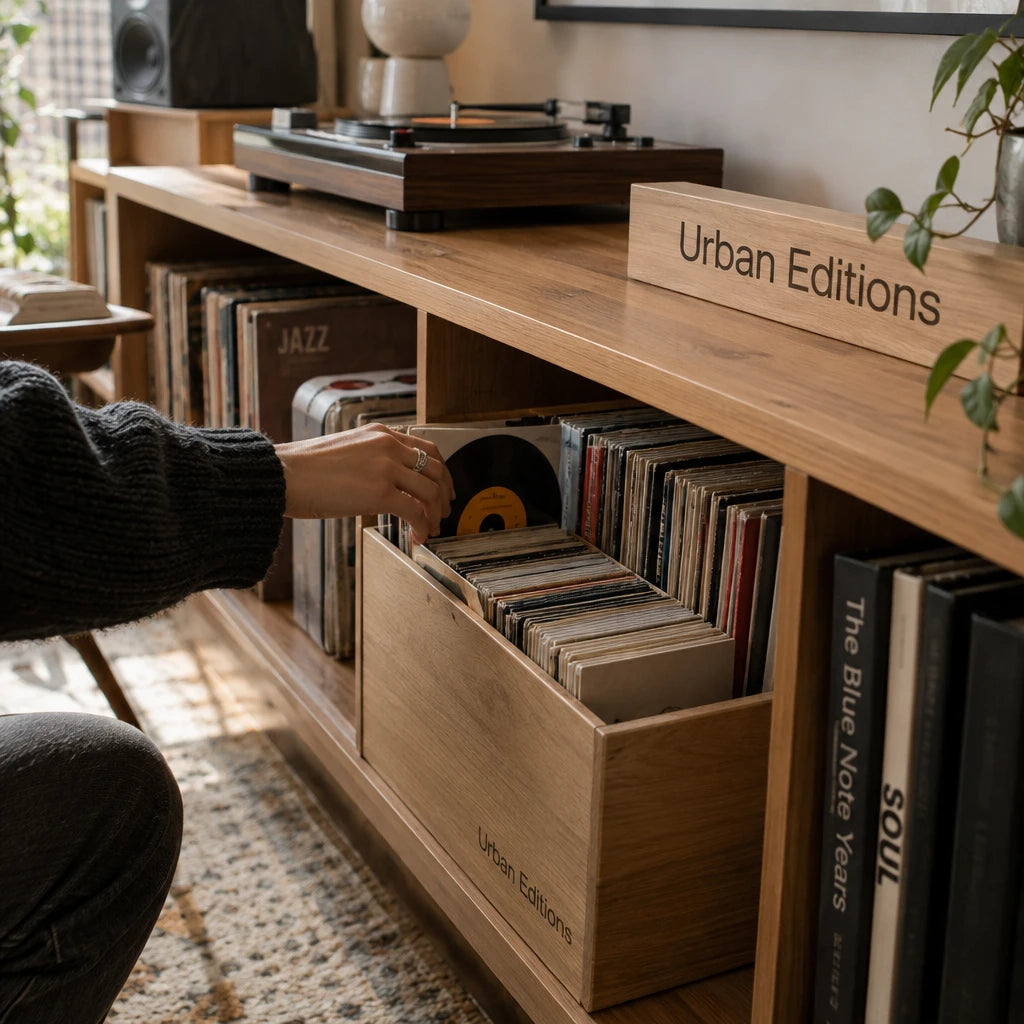
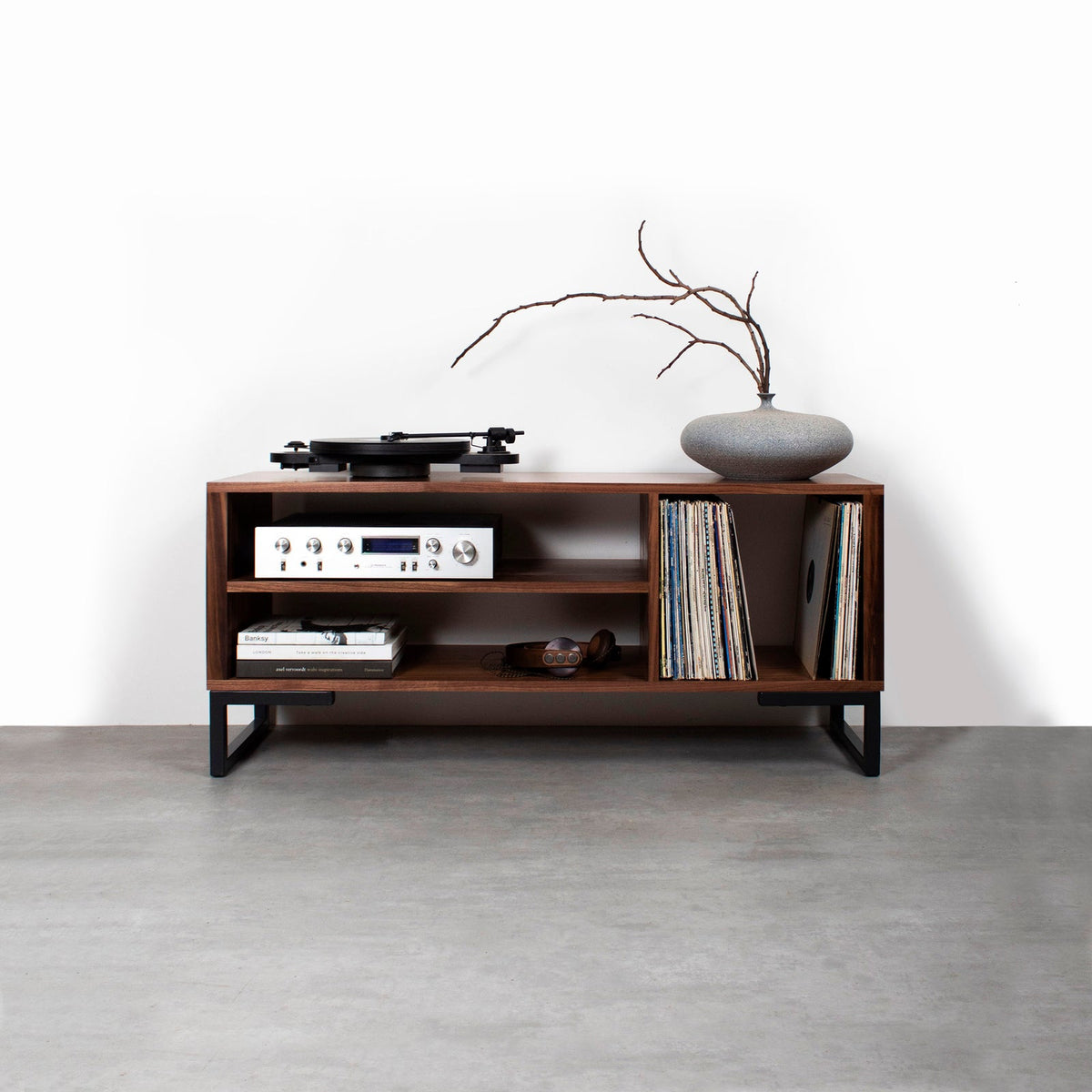
A cabinet suits a collection that belongs beside your hi-fi and gets regular use. It keeps records accessible without bringing boxes out for every listening session, but its layout needs to suit smaller sleeves.
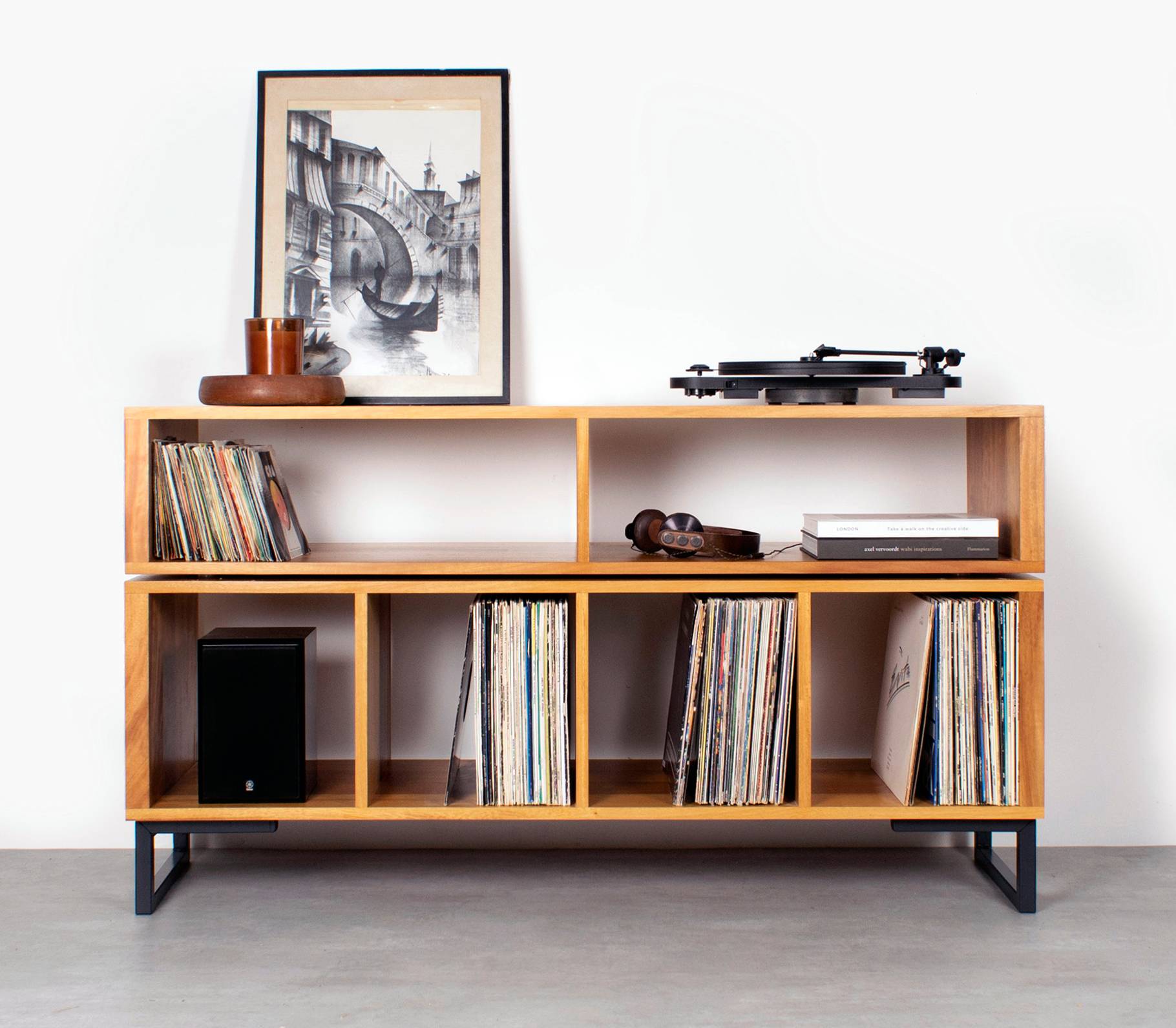
Adapting LP furniture
Yes, you can store singles in furniture designed for 12-inch records. Check fit and support separately, because ample space does not guarantee a useful arrangement.
In a deep LP compartment, singles can disappear towards the back. A removable rear spacer or a shallow insert brings the row forward, making it easier to see labels and grip sleeves.
Wide compartments also need a stable end support. Smaller records do not become self-supporting simply because the shelf was designed to carry heavier LPs.
One practical approach is to place dedicated singles boxes or browsing bins inside larger compartments. Measure the complete box, including its lid and handles, against the cabinet opening. Leave enough room to lift it out without tilting the contents.
Permanent listening storage
A permanent cabinet costs more and takes more commitment than cardboard boxes. Choose it when easier everyday access and a piece of furniture that suits your room justify that investment, rather than simply because the collection has grown.
Plan the record area around usable shelf length, then keep equipment space separate. An amplifier’s ventilation requirements do not change because the surrounding cabinet is intended for records.
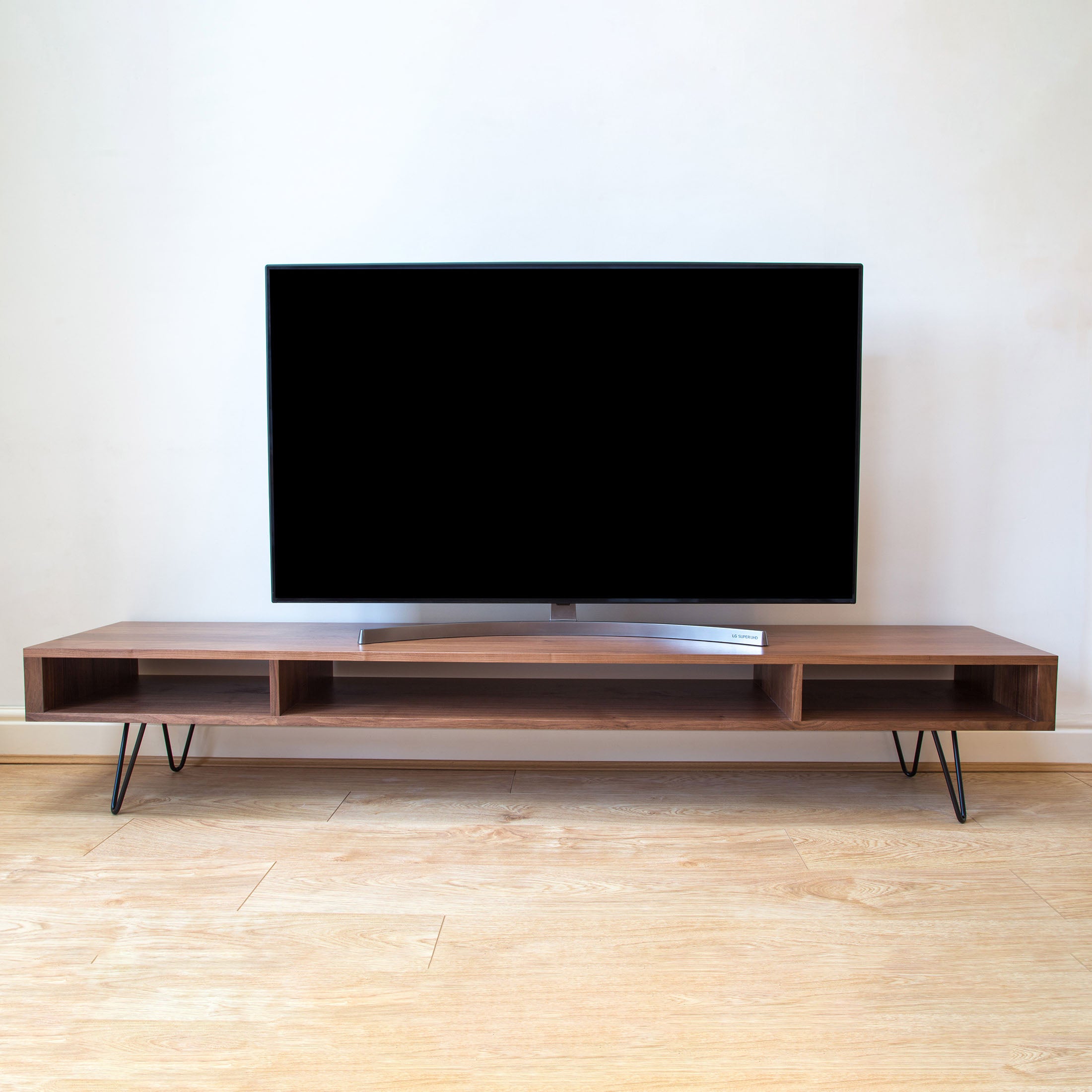
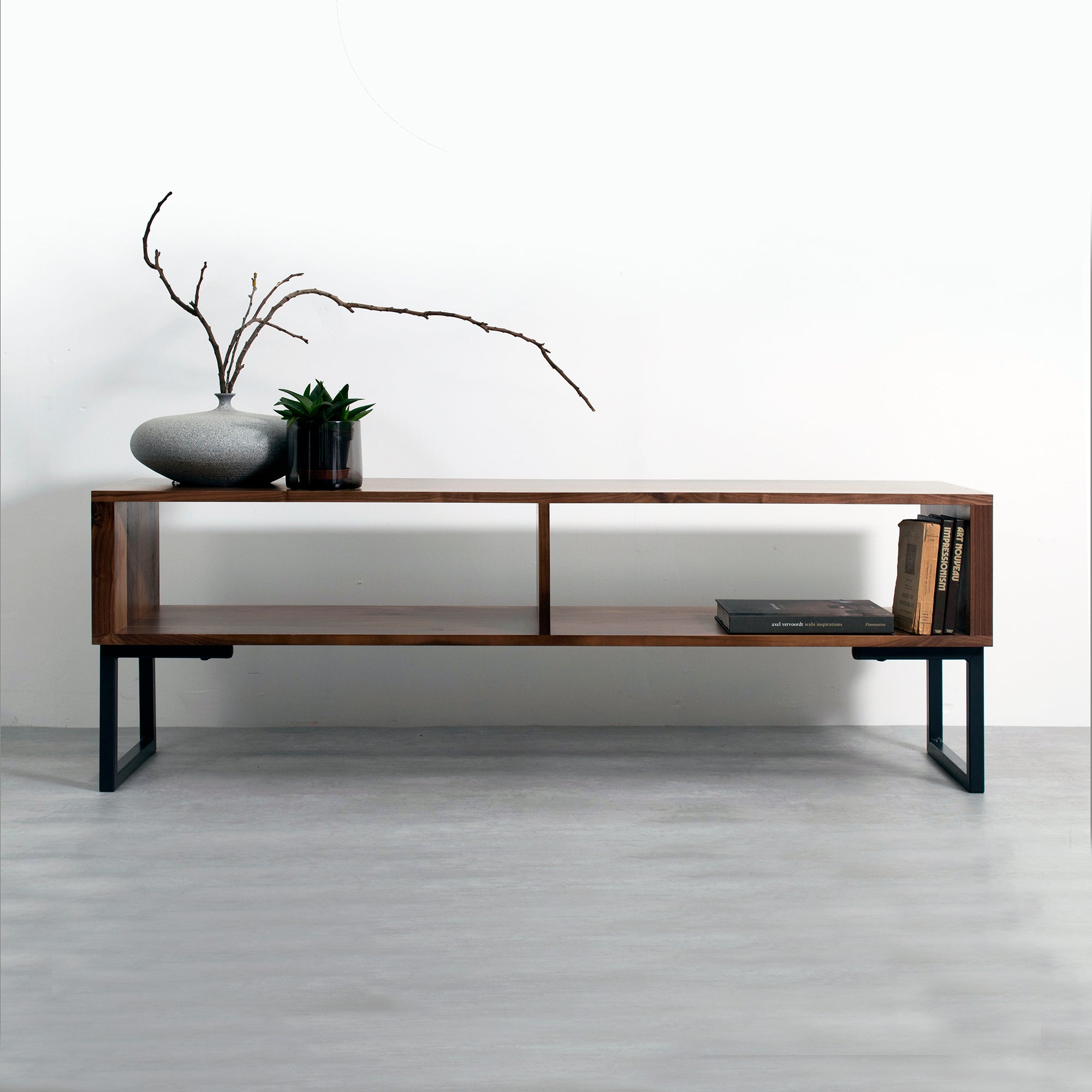
At Urban Editions, we make customisable solid hardwood furniture in the UK. For a permanent listening setup, browse our vinyl storage cabinets and media units with your sleeve measurements, preferred browsing direction and available floor space to hand.
Wood samples help you judge the finish alongside existing furniture. The more useful decision, though, happens inside the cabinet: can you remove a single, return it comfortably and leave the remaining row supported?
Allow room for the collection you expect to keep, rather than filling every section on delivery. A spare compartment gives new purchases somewhere to go without immediately changing the whole filing system.
Conclusion
Measure your largest sleeve, count the records you reach for regularly, and test one manageable row before buying storage in quantity. Choose boxes if most singles form an archive, a rack if you want a small listening rotation, or a cabinet if browsing belongs in your daily setup. Take those measurements into the purchase, including the space needed for supports and your hand.
Frequently Asked Questions
How many 7-inch singles will a storage box hold?
Many compact boxes advertise around 60–75 singles, while larger designs advertise 150 or more. Your usable capacity depends on sleeve thickness and browsing space. Count what fits comfortably with protective sleeves fitted, rather than packing to the advertised maximum.
Are cardboard boxes suitable for long-term record storage?
Yes, sturdy lidded cardboard record boxes suit long-term storage in a dry, stable indoor room. Choose suitable board, keep records supported vertically and follow the stated stacking limits; replace boxes if their bases soften or their sides begin to bow.
Can I keep 7-inch singles with my 12-inch records?
Yes, but give singles their own supported section or removable container. Mixing the two sizes loosely makes smaller sleeves harder to find and lets them slide backwards; a dedicated insert keeps them accessible without altering the whole cabinet.
Should singles face forwards or sit sideways on a shelf?
Face covers forwards when browsing artwork matters most; use sideways rows when compact shelf storage matters more. Thin singles sleeves are harder to identify edge-on than LP spines, so add clear alphabetical dividers to make shelf browsing practical.